
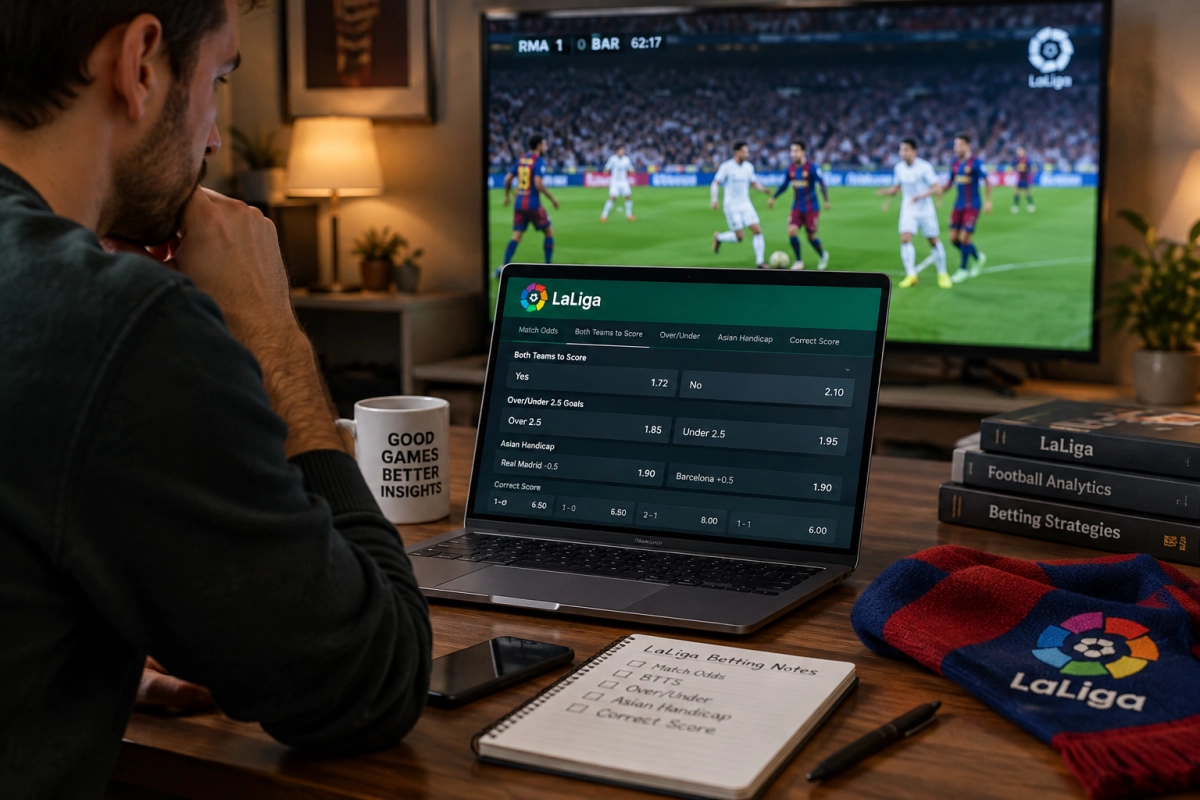
Understanding the Main La Liga Betting Markets
La Liga betting involves far more than choosing which team will win. You can assess match results, goals, defensive strength, team consistency and season-long objectives through markets such as double chance, draw no bet, both teams to score and handicaps. This guide explains how these options work and how to match a market to the evidence available before placing a bet.
For every match, begin with the basics: recent form, home and away records, injuries, suspensions, expected line-ups, tactical approach and fixture congestion. Also check whether a team has a European match shortly before or after the league fixture. These factors can influence performance, but none should be treated as a guarantee of a particular result.
Safer Match-Result Alternatives: Double Chance and Draw No Bet
The standard match-winner market has three possible outcomes: home win, draw or away win. Double chance combines two of these outcomes in one selection:
- 1X: the home team wins or the match ends in a draw.
- X2: the away team wins or the match ends in a draw.
- 12: either team wins, so the match must not finish level.
Double chance can be relevant when a strong home side faces an inconsistent opponent but a draw remains realistic. However, the wider protection normally comes with lower odds than selecting a single winner. You should compare the price with your assessment of the team’s actual chances rather than assuming that a broader market automatically offers better value.
Draw no bet gives you two possible outcomes. If your selected team wins, the bet wins; if the match is drawn, your stake is generally returned. A defeat loses the bet. This market may suit a match where one team has a clear statistical edge but where a draw is still a meaningful possibility, such as a tightly contested fixture between well-organised mid-table teams.
Always check the bookmaker’s settlement rules. Most standard football markets apply to 90 minutes plus stoppage time, excluding extra time and penalties unless the market specifically states otherwise.
Goals, Both Teams to Score and Handicap Markets
Goals markets focus on the total number scored by both teams. With over 2.5 goals, at least three goals are required, while under 2.5 wins when the match produces two goals or fewer. To assess these options, review recent scoring and conceding records, expected attacking line-ups, clean-sheet frequency and the tactical styles of both teams.
Both teams to score (BTTS) wins when each side scores at least once. It may be worth examining when two teams create chances regularly but also concede, although recent results alone can be misleading if opponents or team selections have changed.
Handicap markets adjust the starting position of one team. For example, an Asian handicap of -0.5 requires that team to win, while +0.5 means a win or draw is sufficient. Quarter-goal lines, such as -0.25 or +0.75, split the stake across two nearby handicaps and can produce a partial win or refund.
Next, season-long markets and a structured method for comparing odds can help you judge risk more carefully.
Season-Long Markets: Title, Top Four and Relegation
Season markets allow you to assess a club’s performance over the full La Liga campaign rather than one fixture. The title market is usually dominated by the leading favourites, but a shorter price does not necessarily mean a bet is attractive. Consider squad depth, European commitments, managerial stability, transfer activity and the number of difficult away matches still to play. A team may have an excellent starting XI but lack the resources to maintain its level through injuries and fixture congestion.
The top-four market concerns qualification for the Champions League places. It can offer a wider range of options than the outright title market because several clubs may have realistic paths to the target. When assessing a selection, examine points per match, underlying chance creation, defensive performance and the strength of the teams competing for the same positions. A club’s position in the table may look secure, but a small gap can disappear quickly during a congested run of fixtures.
Relegation markets require a different assessment. Look at a team’s ability to score against comparable opponents, its defensive record, home form and access to January reinforcements. Newly promoted sides may begin strongly before squad limitations become more evident, while an established club with injuries or financial problems can become vulnerable. Check the settlement terms, particularly whether the bet is void if a team is relegated but later reprieved because of an administrative decision.
How to Compare La Liga Odds Across Markets
Odds represent a probability as well as a potential return. To convert decimal odds into an implied probability, divide 1 by the price. For example, odds of 2.50 imply 40% before accounting for the bookmaker’s margin. This does not mean the outcome has a 40% true chance, because the prices in a market normally include an overround.
Compare prices from several reputable bookmakers before placing a bet. A small difference can materially affect long-term results, especially in lower-margin markets or when you regularly make similar selections. Compare like-for-like terms: a goals line of 2.5 is not identical to 2.25, and an Asian handicap may settle differently from a conventional three-way handicap. Also check whether promotions, limits or enhanced odds change the practical value of the offer.
Do not select a market solely because it has the highest odds. A price is potentially valuable only when it is greater than the probability suggested by your own analysis. Keeping a record of your estimated probability, available odds and final result can reveal whether your decisions are well judged, even when individual bets lose.
Matching Market Choice to the Level of Risk
Every market involves uncertainty. Double chance and draw no bet reduce exposure to one result but usually return less, while handicaps and goals markets can offer higher prices with greater reliance on a particular match pattern. Season bets tie up funds for months and may be difficult to trade or reassess if circumstances change.
Set a fixed staking plan and avoid increasing stakes to recover losses. A smaller stake may be appropriate when information is limited, such as before confirmed line-ups or during the opening weeks of a season. Reassess long-term bets when a manager changes, a key player suffers a serious injury or the competitive objectives of the club shift. Betting should remain within an affordable budget, with no assumption that research can remove the possibility of loss.
Making More Informed La Liga Betting Decisions
The best market is not always the one offering the biggest potential payout. It is the option that most closely reflects your assessment of the match or season, the available information and the level of uncertainty involved. Compare equivalent prices, understand the settlement terms and allow for the bookmaker’s margin before deciding whether a selection offers value.
La Liga betting should be approached as a disciplined exercise in probability rather than a way to predict every result. Keep stakes consistent, accept that variance is unavoidable and review your reasoning over time. No strategy eliminates risk, but careful market selection and responsible bankroll management can make your decisions more measured.