
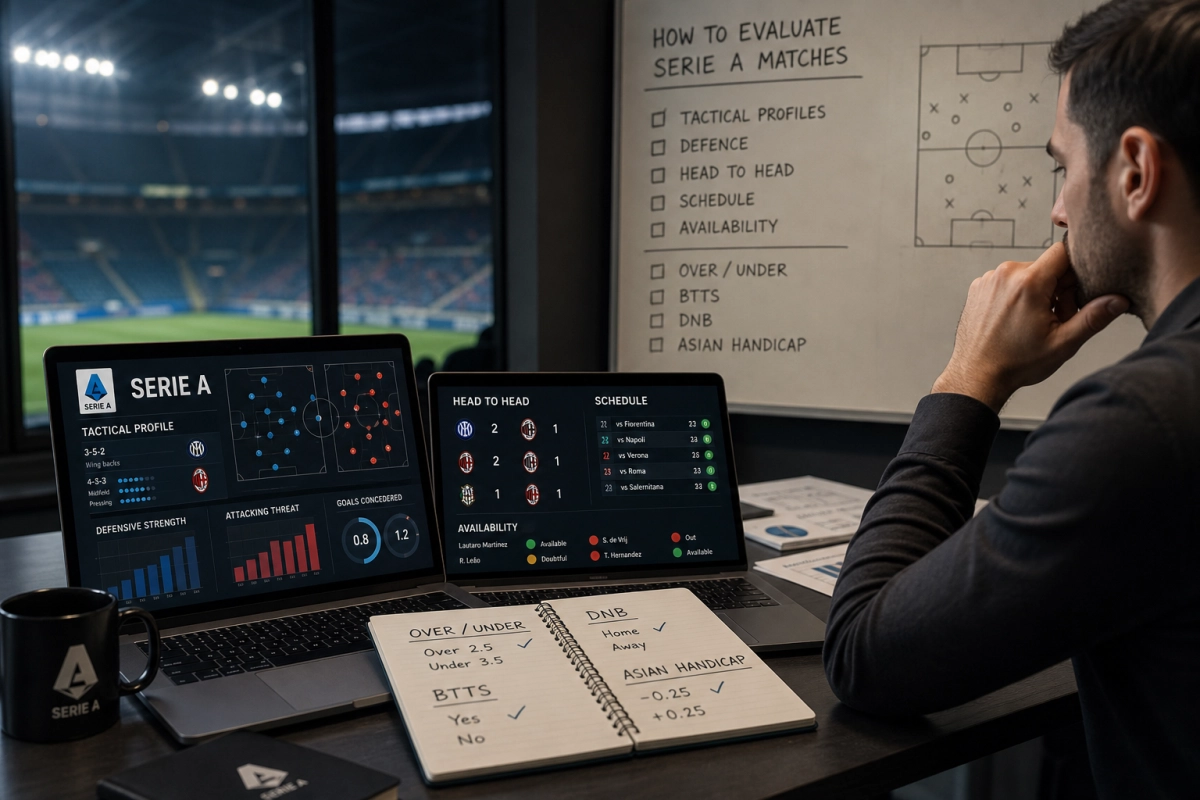
Practical framework for evaluating Serie A matches before you pick a market
This guide shows how to analyse Serie A matches so bettors can choose between Over/Under (goals), Both Teams to Score (BTTS), Draw No Bet (DNB) and Asian Handicap markets. It explains each market in simple terms, then links tactical profiles, defensive records, head‑to‑head trends, schedule congestion and player availability to those markets. Readers will learn what to check before placing a bet and how to separate facts from interpretation. Remember: verify the latest team news and odds before kickoff and bet only if you are of legal gambling age.
Quick primer on the markets to compare
Before using tactical and statistical factors, it helps to define the markets in plain language.
- Over/Under (goals) — a bet on total goals scored by both teams (common lines: 2.5, 3.5). Over 2.5 pays if 3+ goals occur; Under pays if 2 or fewer goals occur.
- Both Teams to Score (BTTS) — a simple yes/no: both teams score at least once. BTTS Yes favours open, attacking games; No favours defensive or one‑sided matches.
- Draw No Bet (DNB) — a win/lose market where a draw returns the stake. Useful when one side is likely but a draw is plausible; reduces risk compared with a straight match-winner bet.
- Asian Handicap — evens the contest by giving or taking fractional goals. A -0.5 handicap equals backing a team to win; -1.0 includes a half-loss/half-push outcome depending on the score.
How tactical profiles and defensive records guide market choice
Match tactics and defensive strength are primary drivers of goals and outcomes. Use the steps below to translate tactical reading into market selection.
- Identify each team’s tactical profile: is the side possession‑based and attacking (likely to create chances), counter‑attacking, or compact and defensive (low lines, sitting blocks)? Possession/pressing teams often push Over/BTTS lines; compact low‑block teams favour Under/BTTS No.
- Check recent defensive records: look at goals conceded per 90, clean sheet frequency, and shots allowed in recent league matches. Consistent low goals conceded increases the appeal of Under 2.5 or BTTS No.
- Consider defensive injuries and rotations: absence of a first‑choice centre‑back, a key full‑back, or a disciplined defensive midfielder can raise goal likelihood. Confirm such facts from official team sheets or reliable reports before betting.
- Match context and styles interaction: when two attack‑oriented teams meet, Over and BTTS Yes are natural candidates. When an organised defensive side faces an efficient counter‑attacker, an Asian Handicap or DNB on the stronger team may offer value while keeping downside limited.
Next, the analysis must fold in head‑to‑head history, fixture congestion and availability to form a balanced market choice — the following section explains how to weigh those factors and compare potential value across markets.
Weighing head‑to‑head patterns and psychological edges
Head‑to‑head (H2H) records are not destiny, but they reveal how styles matched up over time and expose repeatable tactical mismatches or psychological edges. Use H2H to confirm or question your initial read from profiles and defensive stats.
- Look beyond raw outcomes: check goals scored and conceded in the meetings, not just wins or losses. Two 1–0 results imply low chances and defensive control; recurring high‑scoring draws point toward BTTS/Over value.
- Identify stylistic advantages: has one coach consistently exploited the other’s full‑back space or pressed the visitors into mistakes? Tactical leverage that persists across seasons suggests a repeatable influence on goal probability.
- Note situational trends: home/away splits matter — some teams are compact away and expansive at home. If H2H shows the away side reliably shuts down its preferred opponents, favour Under or BTTS No even if aggregate league stats suggest more goals.
- Watch for role‑specific duels: individual matchups can swing outcomes. A dominant winger vs a weak full‑back across historical meetings suggests the targeted side will create chances; that nudges you toward Over or BTTS Yes.
Practical thresholds: if H2H across the last 6 meetings averages ≥3.0 total goals, treat that as a strong signal for Over/BTTS. If at least 4 of 6 were 0–1/1–0/1–1, the match carries a clear defensive bias — favour Under/BTTS No or a cautious DNB/Asian Handicap depending on the expected favourite.
Scheduling, rotation risk and in‑season fatigue
Fixture congestion and travel change how teams are set up. Serie A squads with European or cup commitments, or those on tight domestic runs, rotate differently — and rotation impacts both goals and results.
- Check days of rest: teams with ≤3 days between matches are likelier to rotate and play a conservative XI. That reduces goalscoring and increases the appeal of Under 2.5 and BTTS No.
- Map rotation patterns: some coaches rest creative forwards and keep a defensive core; others rotate full backs and leave attackers intact. If creators are rested, trim Over/BTS expectations; if defenders are rotated, expect more goals.
- Factor travel and midweek fixtures: long trips or Europa/Conference matches midweek raise fatigue and injury risk. Heavy travel + midweek often pushes markets toward DNB and Asian Handicap on the fresher side rather than risky BTTS/Over plays.
- Use squad depth as a modifier: clubs with deeper benches absorb rotation better. If a top team rotates but replaces starters with quality backups who preserve style, markets for wins (DNB/Asian Handicap) remain reasonable.
Translating player availability into market selection
Player news is the final filter that converts analysis into a concrete market pick. Treat availability as binary only for key roles (striker, creative midfielder, centre‑back). For other absences use proportional adjustment.
- Absence of the main striker or creative #10: reduce expected team goals by ~0.4–0.7 depending on reliance. That swings marginal Over 2.5 markets toward Under and lowers BTTS Yes probability.
- Missing first‑choice centre‑back/DM: increase opponent expected goals by ~0.3–0.6 and raise appeal of Over/BTTS Yes. If both teams lose central defenders, Over becomes likelier and Asian Handicap lines widen.
- Late team‑sheet surprises: if a substitute starts, check minutes played recently. A fatigued returning starter is not the same as a fresh rotation option — adjust confidence accordingly or avoid volatile markets.
- Goalkeeper changes: a debutant GK or a keeper with poor recent form inflates both the chance of goals and goalkeeper errors; favour Over and BTTS Yes, and be cautious with tight Asian Handicap backing.
Combine these availability adjustments with H2H and scheduling to choose the market with the best risk/reward. For example: if a possession team loses its #10 and is on short rest but faces a defensive opponent missing a centre‑back, the safest approach may be DNB on the stronger side or a conservative Asian Handicap rather than an Over/BTTS speculative bet.
Pre‑bet checklist
- Verify the confirmed starting XIs and any late team‑sheet changes before placing a bet.
- Confirm days of rest and recent travel for both sides; adjust expectations for rotation and fatigue.
- Compare the implied probability from the odds to your assessed probability — only bet when you see positive value.
- Decide stake size ahead of time and stick to bankroll rules (flat stake or percentage of bankroll).
- If in doubt, prefer a lower‑variance market (DNB or conservative Asian Handicap) or skip the wager.
Practical closing notes
Treat the framework as a living decision filter, not a rigid prescription. Use tactical profiles, defensive form, head‑to‑head context, schedule and player availability to form a probability — then let the market (odds and liquidity) determine whether that probability represents value.
Keep records, review outcomes, and iterate. Over time you will refine how much weight to give each factor for different coaches, venues and phases of the season. Above all, prioritise discipline: confirm last‑minute information, manage stakes responsibly, and avoid forcing bets when the market offers no edge.