
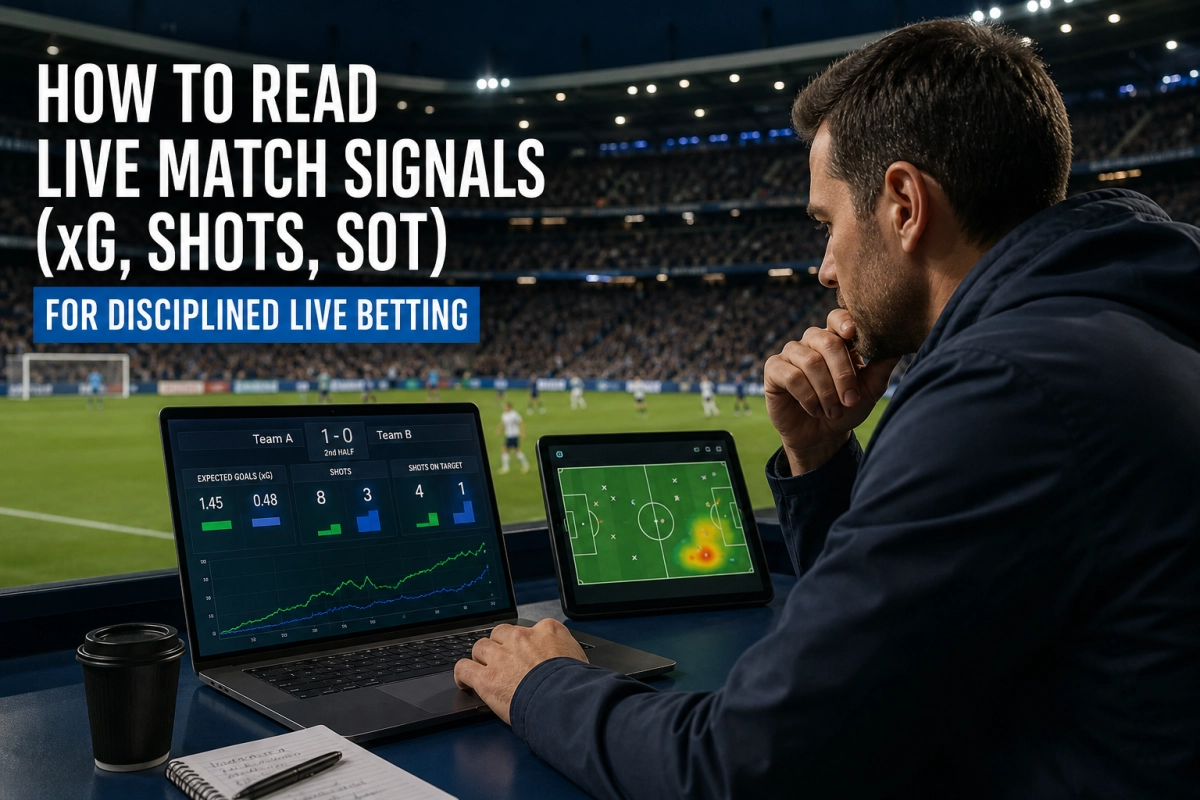
Reading live match signals: why xG, shots and shots on target matter for live betting
This part explains how key in-play indicators — especially expected goals (xG), shots and shots on target (SoT) — provide early, actionable information for live betting. It shows what each metric means, how to track short-term momentum, and how to translate those signals into disciplined bets across markets such as next goal, over/under and Asian handicap. The reader will learn simple rules to reduce impulsive staking and keep bankroll risk manageable while making live decisions.
What each indicator actually measures and why it matters in-play
Before placing a live bet, it helps to know what each statistic represents and its predictive value during a match.
- Expected goals (xG) — a model-based estimate of the chance of a shot becoming a goal based on shot location, type and situation. Live xG graphs show momentum and quality of chances, not just quantity.
- Shots and shots on target (SoT) — raw volume measures. Shots show attacking intent; SoT shows accuracy and direct threat to the goalkeeper. A high shots-to-SoT conversion often precedes goals.
- Caveat — no single metric guarantees outcomes. Use indicators together and consider match context: team tactics, scoreline and fatigue.
Practical checklist: reading xG in real time
The xG graph is often the first signal of sustained pressure. Use this quick checklist when the xG line moves:
- Identify the duration of xG pressure: a single spike (isolated chance) versus a steady upward slope (sustained pressure).
- If a team records several small xG additions in short succession, treat that as sustained territory advantage — higher chance of goals in the next 5–15 minutes.
- Cross-check with SoT: rising xG + increasing SoT is a stronger signal than xG alone.
- Adjust for game state: a leading team sitting back may still have high xG after a counter; interpret accordingly.
Translating shots and SoT into live-market choices
Shots and SoT are fast-read indicators for immediate market plays:
- Next goal market — favour the team with multiple recent SoT and a rising xG slope; avoid betting when the match is balanced despite more long-range shots.
- Over/Under goals — a cluster of high-quality chances (xG + SoT) suggests value on over 0.5 or over 1.5 in the short term; single speculative long-range shots do not justify overs.
- Asian handicap — if the favourite is consistently creating SoT and xG but is level on the scoreboard, small handicap backing (e.g., -0.25/-0.5) can be a disciplined option when odds reflect pressure.
Quick practical rule for discipline: set a predefined maximum stake percentage of the live bankroll for short-term signals (for example 1–2%) and avoid increasing the stake after a loss. Responsible live betting means separate analysis windows for signals and for bankroll control.
Next, the guide will cover corners, possession swings, substitutions and referee patterns — how to spot their combined effect and construct specific live bets such as BTTS, totals and tactical Asian handicap plays.
Corners and possession swings: spotting sustained pressure beyond shots
Corners and possession metrics are second‑order signals: they don’t always produce goals directly, but they often mark sustained attacking pressure or territorial control that translates into chances. Read them as context builders rather than isolated triggers.
- Corners as a pressure amplifier — a sequence of corners inside a short window (3–8 minutes) implies territory plus chaotic set‑piece opportunities. Treat 3+ corners for one side in 10 minutes as “set‑piece danger” and look for correlated rises in xG or SoT before backing overs or next‑goal on that side.
- Quality over quantity — a single corner that results in a shot or headed chance is more predictive than several routine corners that reset play. Cross‑check corner sequences with targeted SoT or a lasting xG slope.
- Possession swings: momentum vs. menace — large possession gains (e.g., 60%+ sustained for 10+ minutes) suggest control but not necessarily imminent goals. Combine possession advantage with increasing SoT, progressive passes into the box or multiple corners to justify short‑term over or BTTS plays.
Quick rules for markets:
- Over/Under (short term): Back over 0.5/1.5 in the next 10–15 minutes when you see sustained possession plus 2+ corners and at least two SoT attempts.
- Next Goal / Team to Score: Prefer the side winning corner sequences if their recent corners lead to shots; avoid betting purely on possession without shot evidence.
- BTTS plays: Favor when both teams are trading corners and possession — balanced territorial exchanges often end with transitional chances from the side that concedes possession.
Substitutions and referee patterns: short‑term catalysts and risk controls
Substitutions and referee behaviour are high‑impact, low‑frequency events. Learn to anticipate their likely effect and protect your stake when uncertainty spikes.
- Substitution types and timing — attacking substitutions (striker/reduced defensive midfield) at 60–75′ often raise the likelihood of goals in the final 20 minutes. Defensive subs or like‑for‑like changes usually dampen immediate value on overs. Late “super‑sub” introductions (75’+) with fresh forwards can be a strong signal for next‑goal or small Asian handicap swings — but only if paired with sustained pressure or tiring defenders.
- Referee patterns — track foul calls, sympathy for advantage, and card frequency. A card‑heavy referee increases stoppage play and set‑piece chances (frequent free kicks near box), raising short‑term overs value. Conversely, lenient referees reduce penalties and breaks — altering BTTS and next‑goal probabilities.
- Penalties and VAR risk — a referee who frequently awards penalties or is quick to call fouls inside the box changes the risk profile: smaller stakes or lay options are prudent if a VAR review window is open.
Practical checklist before reacting to a sub or a referee shift:
- Confirm change type (attacking/defensive) and minutes remaining.
- Look for immediate tactical evidence — formation change, touchmap shift, or quick shot attempt from the substitute.
- Reduce stake when VAR reviews are likely or when the referee’s pattern introduces high variance; increase only if substitution plus clear pressure signals (xG/SoT/corners) align.
Putting signals together: simple rules to build disciplined live bets
Combine the above indicators into a compact decision framework. Think in pairs: what is the pressure signal (xG/SoT/corners/possession)? What is the catalyst (sub/ref/pace/fatigue)? Use this two‑axis check before committing capital.
- Signal + Catalyst = higher conviction. Example: rising xG + 3 corners + attacking sub = consider small stake on next goal for the pressing team or over 0.5 in the next 10 minutes.
- Signal without catalyst = monitor only. Example: high possession but no SoT or corners → no bet.
- Catalyst without signal = low confidence. Example: attacker subbed on but defence not stretched and no shots → avoid or use micro‑stakes (≤0.5% bankroll).
Keep a fixed staking ladder (1% base, 1.5% selective, 2% rare) and never chase losses. Discipline, not instinct, wins in live markets. Part 3 will turn these rules into concrete market scenarios and sample bet flows you can use in real matches.
Sample in-play bet flows
Corner surge: set-piece escalation
Trigger: One team wins 3+ corners within 8–10 minutes, with at least one resulting shot and a rising xG line.
- Market choice: Next goal for the corner-winning team or over 0.5 in the next 10–15 minutes.
- Stake: 1–1.5% of bankroll (use the lower end if scoreline is close and referee is card-heavy).
- Entry rule: Place bet only if SoT or renewed xG accompanies the corner sequence; avoid purely routine corners.
- Exit rule: Cash out or hedge if pressure dissipates (no shots in next 5 minutes) or conceding counter occurs.
Late attacking substitution: super‑sub scenario
Trigger: Attacking forward introduced after 75′ while the team is pressing and opponents show fatigue or have given up multiple clear chances recently.
- Market choice: Small Asian handicap (-0.25/-0.5) on the attacking team or next goal (if odds are reasonable).
- Stake: 1–2% depending on prior pressure; use 0.5–1% if substitution is isolated without immediate shots.
- Entry rule: Wait up to 5 minutes to confirm substitute involvement (touches in final third, shots or key passes).
- Exit rule: Reduce or close position if the substitute has no impact or the defence regains shape; consider in-play hedge if a counter chance arises against you.
Possession swing with shots: controlled buildup
Trigger: Sustained possession (60%+) for 10+ minutes, accompanied by progressive passes into the box and 2+ SoT.
- Market choice: Over 0.5/1.5 in the short window, or backing the favoured team on -0.25 Asian handicap when odds compress.
- Stake: 1% base, up to 1.5% if corners or a recent big xG chance appears.
- Entry rule: Require at least two SoT or a meaningful xG uptick before committing.
- Exit rule: If possession remains sterile (no shots for 6–8 minutes) or the opponent launches effective counters, close or avoid further exposure.
Final notes on discipline and adaptability
Live indicators give repeated opportunities but also create emotional pressure to act. The clearest edge comes from disciplined, repeatable processes: predefined triggers, consistent stake sizing, and strict exit rules. Treat each signal as a hypothesis to be tested, not a certainty to be chased.
Keep a simple log of every live trade (trigger, market, stake, outcome) and review patterns weekly — which signals produced wins, which created noise. Over time, this small habit sharpens judgment and prevents overconfidence from a few lucky wins.
Finally, accept variance. Even the best-read xG and shot patterns will fail sometimes. Protect your bankroll by limiting exposure, sticking to your ladder, and stepping away when the market or personal focus is compromised. Live betting rewards patience, consistency and the ability to adapt rules when fresh, verifiable patterns emerge.