How to approach Betting on Premier league: markets and match factors explained
This guide explains the most common Premier League betting markets and shows how to read team form, home and away records, injuries, rotation risk, fixture congestion and tactical matchups. Readers will learn what each market means, how to interpret on-pitch factors that affect odds, and which signals matter most before placing a bet.
Key betting markets: what they are and when to use them
Before analysing a match, it helps to understand the markets available. Definitions are written for beginners; experienced bettors can skip to tactical notes.
Match result (1X2) and Double Chance
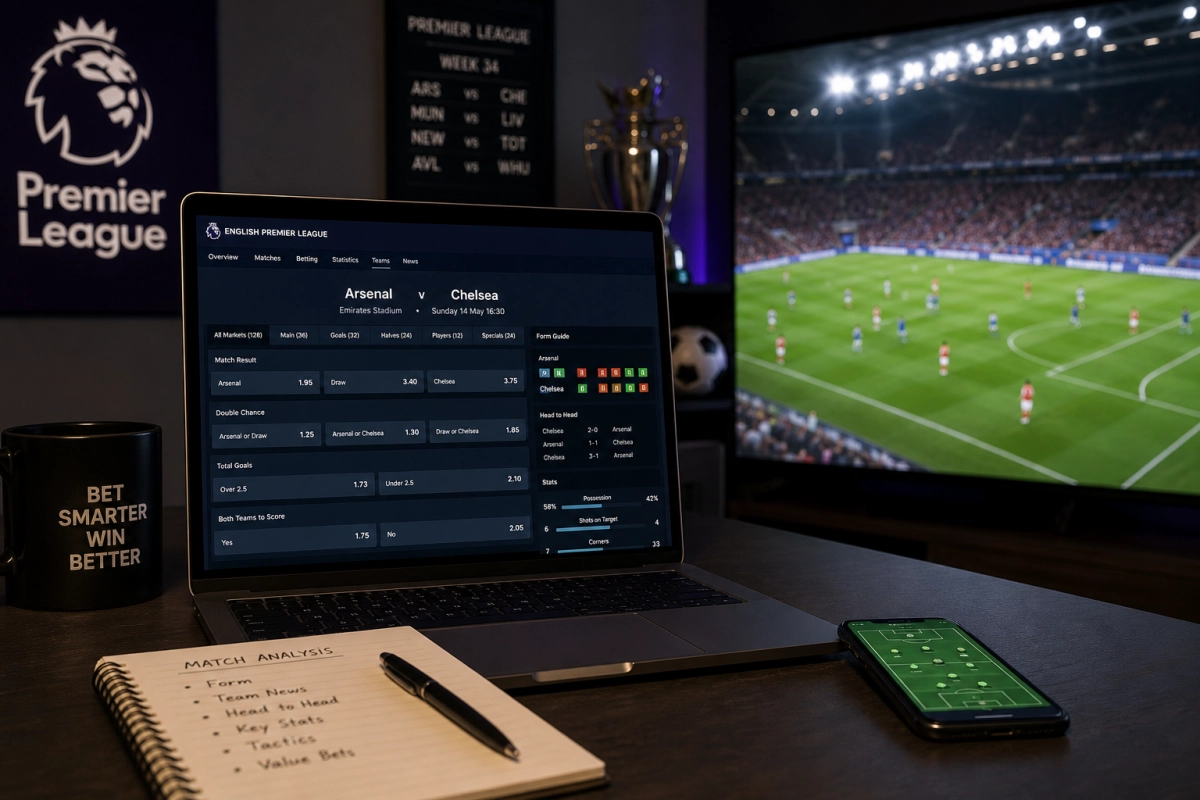
- Match result (1X2): A simple market on home win, draw or away win. It’s decisive but often offers lower value when teams are evenly matched.
- Double Chance: Covers two outcomes (home or draw, away or draw, home or away). Use when a draw is likely or when avoiding a single-match loss matters.
Over/Under goals
Over/Under markets (commonly 2.5 goals) bet on total goals in a match. Choose lower lines (under 2.5) for defensive matchups and higher lines (over 2.5 or over 3.5) when both teams score freely or key defenders are absent.
Both Teams To Score (BTTS)
BTTS asks whether both sides will score. It’s useful when teams play open football or when one side struggles defensively. Opposite is “No” for clean-sheet expectations.
Asian handicap
Asian handicap removes the draw by giving one team a goal advantage or deficit. It can be split (quarter lines) to reduce variance. Use handicaps to find value when bookmakers set a narrow favourite but match conditions suggest a closer contest.
Doubles and Accumulators
Doubles combine two selections; accumulators combine three or more. Payouts grow quickly with each leg, but risk increases because one losing leg voids the whole return. Keep accumulators small and realistic.
Reading form and match context: the factors that move markets
Odds reflect many variables. Learning to read those variables helps identify value opportunities.
Recent form and statistical trends
- Look at last 5–10 matches rather than a single result. Check goals scored/conceded, clean sheets and shots on target to identify styles.
- Separate league and cup form; some teams rotate heavily in cups which distorts overall trends.
Home and away records
Home advantage in the Premier League is significant. Compare a team’s home goals per game and points-per-game at home versus away. Some teams are much stronger at home; others are travel-resistant.
Rotation risk, injuries and suspensions
- Rotation risk: Teams in European competition or with congested schedules may rest key players. Expected XI matters more than reputation.
- Injuries/suspensions: Missing a creative midfielder or a centre-back can change both attacking output and defensive stability.
Fixture congestion and squad depth
Multiple fixtures in a short span increase fatigue and injuries. Teams with deeper squads cope better; smaller squads often show performance drops after intensive periods.
Tactical matchups
Consider playing styles: a high-pressing team vs a side that plays out from the back can create turnovers and chances. Look for mismatches (pace against slow full-backs, aerial strength vs weak centre-backs) that influence goal and BTTS markets.
These market definitions and match factors set the foundation for comparing odds and sizing stakes responsibly. In the next section, the guide will show step-by-step how to compare bookmaker markets, calculate implied probability, and size stakes to protect your bankroll.
How to compare bookmaker markets and calculate implied probability
Finding value starts with comparing prices. Follow a simple routine before you place a bet.
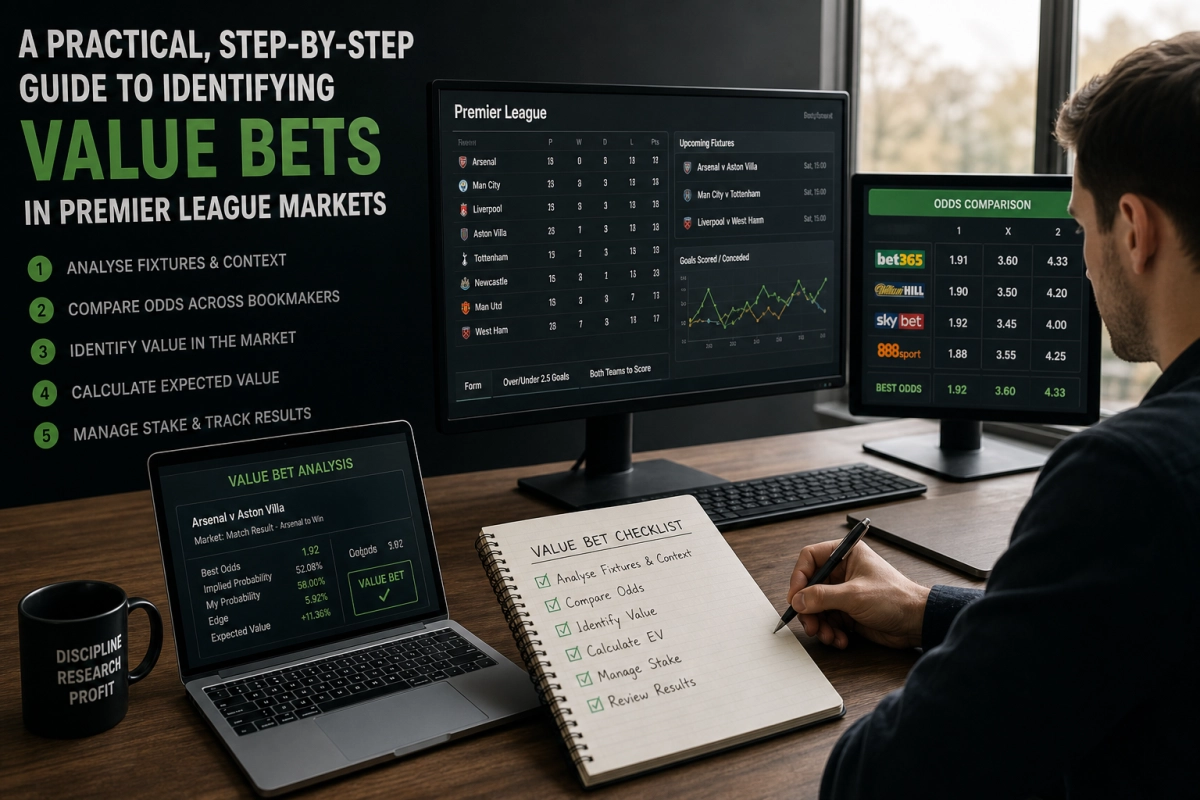
- Gather odds from at least three bookmakers and an exchange (if possible). Use a single snapshot close to kick-off and note movements — late changes often reflect team news.
- Convert decimal odds to implied probability: implied probability = 1 / decimal odds. Example: 2.50 → 1 / 2.50 = 0.40 (40%).
- Check the market overround: add the implied probabilities for all outcomes (home/draw/away). If the sum is greater than 100%, the excess is the bookmaker’s margin (vig). A heavy overround implies inflated prices.
- Estimate your own probabilities based on form, tactical matchup, injuries, home/away and any other contextual adjustments you’ve researched. Be explicit: write down your percentage for each outcome.
- Compare your probabilities to the best available implied probabilities. A value bet exists when your estimated probability > bookmaker implied probability. Calculate edge: (your prob – implied) / implied gives a sense of value size.
Example: you estimate a team has a 45% chance to win. Best decimal odds available are 2.50 (implied 40%). Since 45% > 40%, there’s value. The edge is (0.45–0.40)/0.40 = 12.5%.
Sizing stakes responsibly: bankroll rules, staking plans and bet selection
Once you’ve identified value, decide how much to risk. Preserve your bankroll with clear rules rather than impulse bets.
- Set a bankroll: only bet money you can afford to lose. Define a betting unit as a small percentage of that bankroll (commonly 1–3%).
- Flat staking: stake the same unit on each qualifying value bet. It’s simple and limits variance.
- Percentage staking: stake a fixed percentage of the current bankroll; your stake shrinks after losses and increases after wins.
- Kelly criterion (fractional): Kelly suggests optimal size relative to edge and odds: stake% = (edge / odds-1). Use fractional Kelly (e.g., half Kelly) to reduce volatility and avoid overbetting.
Practical rules of thumb:
- Keep single-match stakes conservative (1–3 units). Increase slightly for very strong edges but avoid >5% of bankroll on a single bet.
- Use doubles and small accumulators sparingly. Because variance compounds, treat multi-legged bets as entertainment unless each leg is independently a value bet and stakes are reduced accordingly.
- Record every bet: market, odds, stake, rationale and result. Tracking lets you review hit rate, ROI and whether your model of probabilities is calibrated.
Other considerations: line-shop to the best price, use exchanges to lay or hedge where appropriate, and avoid cash-outs that destroy expected value unless reducing guaranteed loss fits your risk tolerance. By consistently comparing markets, quantifying your edges and staking within strict bankroll rules, you’ll transform intuition into a disciplined, long-term approach to Premier League betting.
Pre-match checklist: the routine to follow before you bet
- Confirm team news: final line-ups, confirmed injuries, and any late suspensions — these often change value quickly.
- Assess rotation risk: check European or cup fixtures in the last 7–10 days and manager comments on squad selection.
- Review tactical matchup: identify styles (pressing, counter, possession) and specific player matchups that influence goals or clean sheets.
- Compare prices: line-shop across several bookmakers and an exchange; note which market offers the best implied probability for your selection.
- Calculate implied probability and your estimated probability, then quantify the edge before betting.
- Set the stake using your chosen staking plan (flat, percentage, or fractional Kelly) and ensure it fits your bankroll rules.
- Decide on bet type: single, double, accumulator — size accumulators smaller and only include legs you rate as value.
- Record the bet: market, odds, stake and brief rationale so you can review outcomes and refine your process.
- Set limits and stick to them: predefine loss limits, take-profit points and maximum bets per day or week.
Final remarks on building a durable betting approach
Betting consistently well is less about finding a single perfect tip and more about developing a repeatable process: gather clear information, quantify your edge, protect your bankroll and learn from every outcome. Maintain discipline, keep detailed records, and treat staking and market comparison as routine skills you can improve. Above all, prioritise responsible behaviour — bet only what you can afford to lose, set boundaries, and seek help if gambling stops being fun or starts to harm you or others. Small, steady improvements to your process will compound into better decisions and greater control over your betting over time.