How to spot La Liga matches likely to produce goals in specific periods
This guide explains how to analyse La Liga matches for time-based betting markets — first-half goals, second-half goals, late goals (75’+), halftime/fulltime and anytime scorers. Readers will learn which statistics to check, the tactical signs that matter and the match contexts that raise or lower goal probability in particular periods. All advice is educational and intended for adult bettors who will verify live information before placing any bet.
Key betting terms and markets explained
Before diving into analysis, a quick definition of the markets discussed:
- First-half goals / Second-half goals: bets on whether a goal is scored in the respective 45-minute period.
- Late goals (75’+): bets that at least one goal will occur from the 75th minute to full time.
- Halftime/Fulltime (HT/FT): predicts the result at half‑time and at full‑time (e.g., draw/away).
- Anytime scorer: bet that a named player will score at any point during the match.
- Over/Under goals: total goals in the match, commonly used to support time-based markets (e.g., Over 1.5).
Beginner bettors should familiarise themselves with these terms and use small stakes while learning. Always set a budget and avoid chasing losses.
Step-by-step pre-match analysis for first-half and second-half markets
Use a consistent checklist to compare matches. Follow these numbered steps before considering a La Liga betting market.
-
Check recent form by half:
Look for goals-per-half and xG (expected goals) split by first vs second half. Teams that score a high share of their xG before half-time often offer value on first-half goals; those stronger after the interval may support second-half markets.
-
Assess starting line-ups and rotation:
Confirmed line-ups matter. If a team rests key attackers or uses experimental tactics, first-half goal probability usually drops. In La Liga, managers managing fitness for European fixtures often rotate, affecting early goal output.
-
Tactical style and pressing intensity:
High-pressing, quick-transition teams create early chances and more first-half goals. In contrast, low-block, possession sides may concede more late goals as opponents chase openings.
-
Set-piece and aerial threat:
Teams strong on set-pieces or that win many corners often score late goals from fatigue and crosses. Aerial dominance increases anytime scorer chances for target forwards.
-
Fixture congestion and substitutions:
Teams with tight schedules or many away miles are more likely to concede late as legs tire — useful for 75’+ markets and second-half overloads.
Tactical signs and match contexts that suggest late goals or HT/FT volatility
- Frequent late substitutions and attacking changes by coaches — they increase late goal chances.
- Teams that concede a high percentage of goals after the 75th minute in recent games signal late goal risk.
- Squads with poor defensive depth or frequent yellow/red card issues are more likely to concede late.
- Head-to-head trends: some pairings historically open up late due to tactical familiarity or rivalry intensity.
These pre-match checks create a structured view of which period a goal is more probable. The next section will show how to combine live-match signals and bookmaker markets to refine timing-based selections.
Combining live-match signals with minute-by-minute stats
Pre-match work narrows candidates; in-play analysis converts candidates into bets. Track a concise set of live signals that reliably foreshadow goals in specific periods:
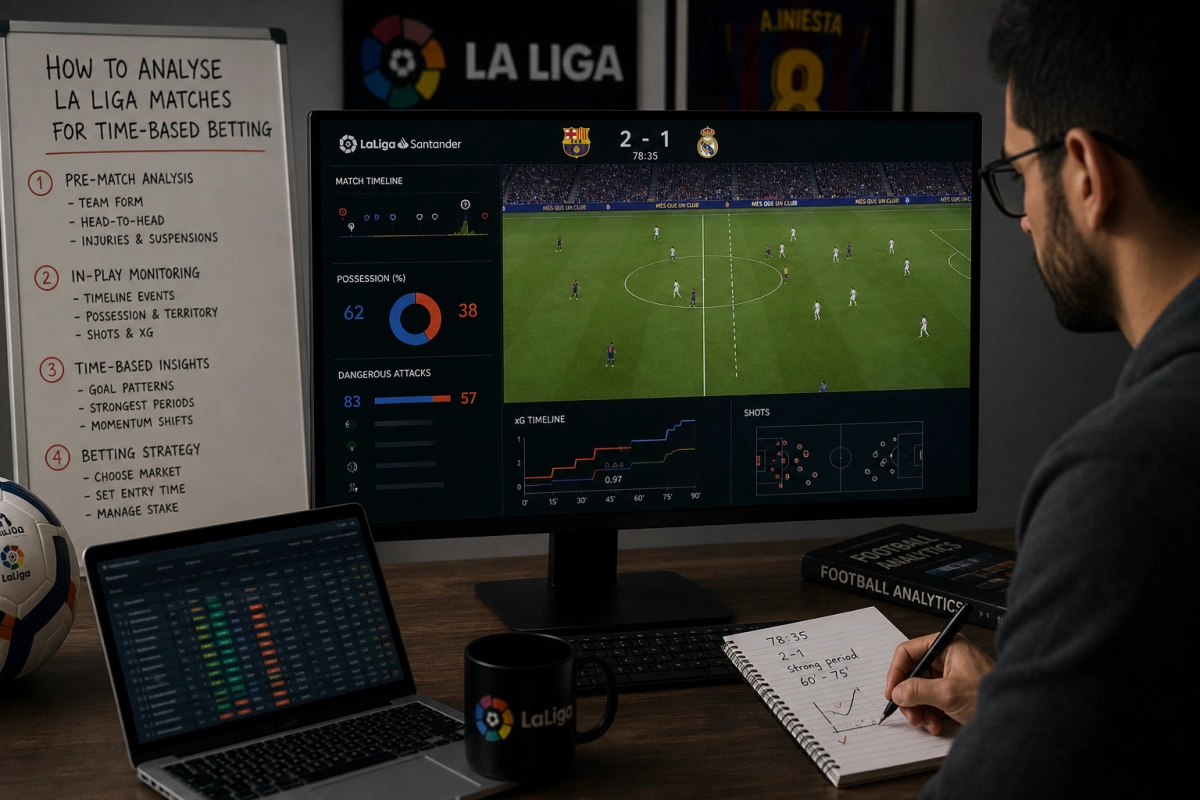
- Shot volume and quality trends: monitor shots and xG by 15‑minute blocks. A team piling up high-xG chances in the opening 25–35 minutes suggests first-half goals. A surge after 60′ — especially high-quality chances from central areas — points to second-half and late-goal probability.
- Attack tempo and possession in final third: live heat maps and final-third possession are powerful. If a team increases entries into the box or repeats three-or-more-touch sequences in the box, the next goal is more likely to occur in the current half.
- Corners and set-piece pressure: multiple corners inside a short window usually translate into a higher short-term scoring chance, notably in late-game scenarios when defenders tire. Accumulate corner count by team and minutes since last corner — clusters matter.
- Substitution patterns: watch who comes on and when. Attacking substitutes introduced around 60–75′ combined with a team already increasing forward intent are classic triggers for 75’+ markets. Conversely, defensive switches when protecting a lead reduce late-goal risk.
- Card accumulation and numerical disadvantage: cards change match shape. A yellow or red on a defender often spikes immediate xG against; two-booked defenders or tactical fouls in the box are precursors to late goals from set-pieces or counter spaces.
- Fatigue indicators: distance covered and sprint counts (available from match trackers) falling below season averages for a team after 60′ signal wear and tear — more space for counters and late goals.
How to use bookmaker markets and live odds to refine timing bets
Bookmakers’ odds and market movements are a real-time crowd-sourced indicator of scoring probability. Use them systematically rather than reactively:
- Implied probability and overlays: convert odds to implied probability for the market you want (e.g., odds for “goal after 75’”). If in-play events (corners, shots) push implied probability up rapidly, that movement can confirm a live bet. Conversely, if the market remains flat despite clear attacking pressure, you may have value.
- Alternative markets as confirmations: watch related lines — total corners, shots on target, cards and HT/FT. A sudden shortening of “Over 3.5 corners” or “Home team anytime scorer” supports a late-goal or scorer bet more than raw possession stats alone.
- Timing your entry: for late-goal (75’+) markets, target the 60–75′ window when attacking substitutions have had time to impact and bookies are still adjusting. For first-half goals, early in-play odds after a flurry of chances (10–30′) often give the best value before sharp corrections.
- Use Asian lines and cash-out wisely: Asian markets can protect partial stakes when you expect pressure but not certainty. Avoid emotional cash-outs: only use them to lock profit when the live evidence contradicts your read (e.g., key attacker forced off).
Player-level signals for anytime scorer and HT/FT selection
Anytime scorer and HT/FT bets hinge on player roles and tendencies as much as team patterns. Check these micro-factors quickly pre-match and in-play:
- Minutes and substitution likelihood: strikers who rarely complete 90 minutes reduce late-goal chances; look for players averaging 80+ minutes if targeting 75’+ scores. Bench forwards known to play late can be good anytime options if they regularly score after coming on.
- Set-piece and penalty duty: designated penalty takers and primary free-kick targets carry outsized anytime-scoring value. If a team earns many late fouls in the box, these players’ anytime odds shorten fast.
- Shot location and xG per shot: players taking shots from central zones and inside the box have higher conversion probability. Prioritise forwards with a high shots-on-target rate and xG per 90.
- Match-up exploitation: pair player traits with opponent weaknesses — a tall target man vs a team conceding aerial duels, or a quick forward vs a slow full-back — to spot HT/FT and anytime opportunities.
Quick in-play decision flow
- Pre-match: shortlist matches using half-split xG, set-piece threat and likely XI.
- Kick-off to 30′: if high-quality chances accumulate for either side, prioritise first-half goal and anytime-scorer lines; if not, move to watch second-half windows.
- 30’–60′: track substitutions, corner clusters and shot quality; a sustained increase in central chances shifts probability toward second-half and late goals.
- 60’–75′: this is the prime window for 75’+ markets — confirm with attacking subs, fatigue indicators and live odds movement before staking.
- 75’+: act quickly on clear attacking pressure, set-piece frequency or numerical advantage; otherwise preserve bankroll for better edges.
Putting the method into practice
Treat this approach as an operational process rather than a shortcut to guaranteed wins. Test ideas with small stakes, log every trade and measure outcomes by market and motif (e.g., late goals after attacking subs, first-half goals from high press). Over time, the best profits come from disciplined selection, strict bankroll sizing and learning which signals your bookies misprice most often. Above all, remain patient: variance is inherent in football, so consistent, evidence-led decisions—not emotion—produce long‑term edges.