
How to read live betting odds movements and what they tell you
Live betting requires quick interpretation of odds changes. This guide explains the main market signals—drift/shortening, liquidity, market gaps, public bias and latency—so readers in Tanzania and other Swahili-speaking markets can evaluate events in domestic (for example Tanzania Premier League or CAF competitions) and international fixtures. The reader will learn what each signal means, practical checks to run during a match, and basic responsible staking reminders to protect a betting budget.
Core market signals and simple examples
Before using live betting markets, define three basic concepts: implied probability (odds converted to percent), market liquidity (how much money is available at the odds) and price movement (odds rising or falling). Below are the key signals to watch and how to interpret them.
Drift (odds lengthen) and shortening (odds tighten)
Drift: when an outcome’s odds increase (e.g., from 2.00 to 2.50), implied probability falls. Shortening: odds fall (e.g., 3.00 to 2.40), implying increased market belief. Shortening often follows insider news (an injury or substitution), large bets from sharps, or information from in-play events.
- Practical example: in a Tanzania Premier League match a sudden substitution of a key striker may trigger shortening for the away team if live momentum favours them.
- Interpretation: short, sharp shortening with increased volume suggests informed money; slow, steady shortening with small volume may reflect public attention.
Liquidity and market gaps
Liquidity is how easily you can place a bet at displayed odds. Thin liquidity causes larger jumps between available prices (market gaps). Big money markets (Champions League or major international fixtures) usually show finer odds movement than local matches with thin liquidity.
- Practical example: a CAF Champions League tie will usually have smaller gaps than a lower-profile domestic game because more money and more bookmakers participate.
- Interpretation: avoid trusting a narrow price move in illiquid markets unless volume confirms it—gaps can be noise or simply lack of matched bets.
Public bias and latency
Public bias occurs when casual bettors favour favourites, overs, or star players. Markets can overreact in the public’s direction, creating potential value on the other side. Latency is the delay between an in-stadium event and its reflection in online prices—useful for sharp live traders but risky for casual punters using slow apps or streams.
- Practical example: in international friendlies, public bias often pushes obvious favourites shorter; contrarian live moves may appear as better value.
- Interpretation: if your streaming lag is 10–20 seconds behind the market, you may see odds already corrected—only place bets if your feed and bet placement are fast enough.
Rapid pre-bet checks to run during a live market
Before committing money in a live market, run these quick checks. They are structured so beginners can follow them and experienced bettors can use them as a checklist.
- Confirm the information: is the change linked to a confirmed event (goal, red card, substitution) or only a rumour?
- Check liquidity: can you get your desired stake at the displayed odds or will your bet move the price?
- Compare markets: are several bookmakers showing the same movement, or is it isolated?
- Assess timing and latency: is your stream and app updated fast enough to act on the move?
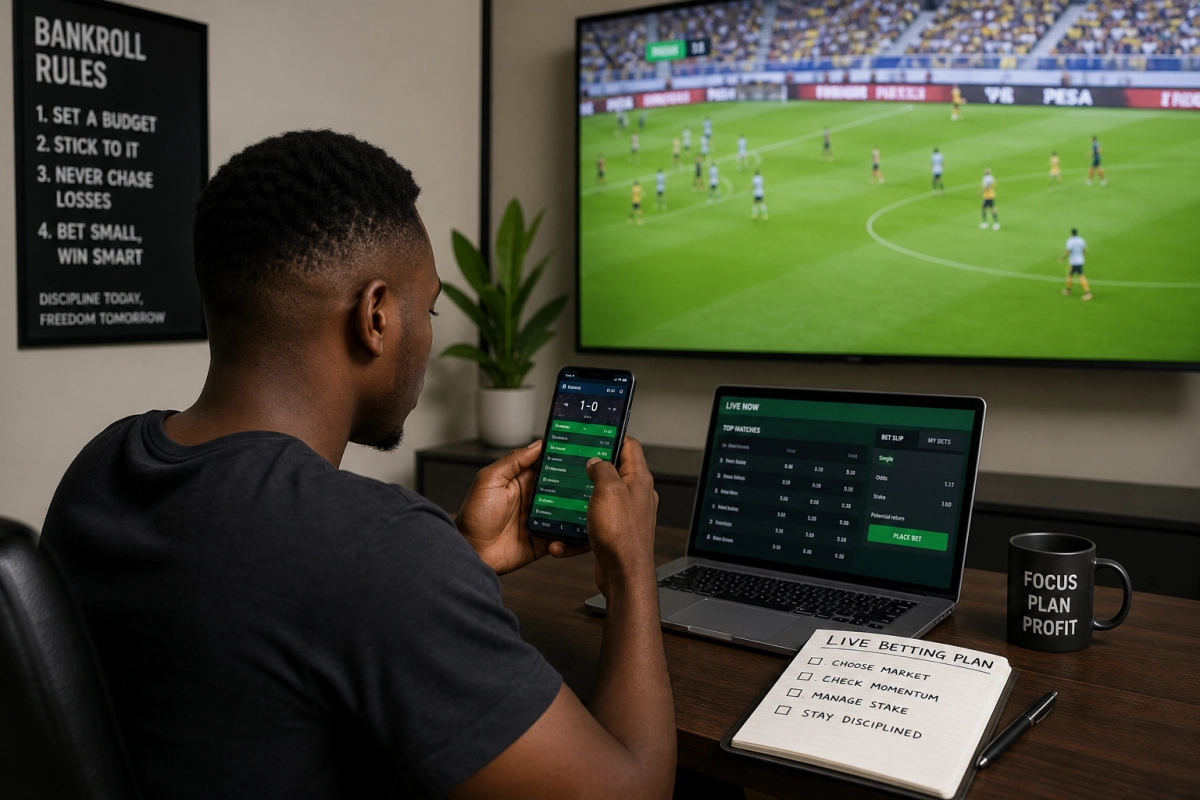
- Size your stake: use a fixed fraction of bankroll for live bets and reduce size if uncertainty or low liquidity exists.
These initial concepts and checks set the foundation for step-by-step live routines and worked examples from both African domestic matches and international fixtures in the next section.
Step-by-step live trading routines you can run in 30–60 seconds
Below are two compact routines: one for spotting sharp/informed moves and one for contrarian value when public bias looks dominant. Each routine is time-ordered so you can follow it during fast-moving live markets.
Routine A — detect a sharp/informed move (use when you suspect insider or large-bet activity)
1. Spot the trigger: confirm a concrete event (goal, red card, confirmed substitution) via primary feed or referee feed. If you can’t verify it, pause.
2. Cross-check price action: open two or three bookmakers (or an odds comparison) and confirm the same shortening appears across them. If only one book shows movement, treat as isolated.
3. Check liquidity quickly: view the available stake at the new price. If exchanges or major books show substantial matched volume, treat as stronger signal.
4. Estimate magnitude: convert odds to implied probability (odds 3.00 → 33.3%; odds 2.20 → 45.5%). A jump like that signals a meaningful re-assessment.
5. Size the stake: use a fixed fraction of bankroll (example: 1–2% for most live punts; reduce to 0.5–1% in thin markets). Don’t bet full indicated value at first — consider scaling in (half now, half after confirmation).
6. Execute and manage: place the bet, set a clear exit/hedge threshold (cash-out, in-play hedge) and record the trade.
Routine B — fade public bias (use when crowd-driven shortening appears)
1. Identify public patterns: heavy shortening on favourites after a routine event (e.g., early shot on target, minor substitution) with no corroborating volume.
2. Confirm latency/streaming: ensure your feed is up-to-date; public moves often lag high-liquidity books and correct quickly. If your stream lags >10–15s, avoid reacting.
3. Compare markets: if the majority of books remain steady and only popular retail books shorten slightly, the move is likely public.
4. Size conservatively: bet on the opposite outcome with a smaller stake (0.5–1%) or use a lay/hedge to reduce exposure.
5. Exit plan: set a firm loss limit for the market (for example, cut if price moves further against you by a defined amount) and record reasoning for later review.
Worked examples from African and international fixtures plus staking rules
Example 1 — Tanzania Premier League (thin liquidity)
– Scenario: Away team odds shorten from 3.50 to 2.75 after a late substitution. Only one regional book shows the move, and available stake at 2.75 is small.
– Action: Treat as low-confidence. If your standard unit is 1% of bankroll, reduce to 0.5% or skip. If you bet, scale in: 50% of planned stake now, 50% only if other books follow. Record the event and outcome.
Example 2 — CAF Champions League / Champions League (higher liquidity)
– Scenario: Home win shortens from 2.40 to 1.95 across multiple books after an injury to the away captain. Matched volume is visible on the exchange.
– Action: Higher confidence of informed money. Use full live unit (e.g., 1–2% depending on your risk profile). Consider placing the full stake or scaling with a clear hedge plan if the expected value is marginal.
Practical staking rules
– Unit sizing: keep live units smaller than pre-match units. Typical live unit = 0.5–2% of bankroll depending on liquidity and confidence.
– Maximum exposure per match: cap total live exposure (e.g., no more than 5–8% of bankroll across all live positions in the same fixture).
– Stop-loss and cooldown: if you lose several live bets consecutively, enforce a cooldown period to avoid chasing.
– Record-keeping: log event, market, odds in/out, stake, reason, and result. Over time this identifies which routines and markets you read well.
– Adjust for liquidity: halve your unit size in thin markets or when latency is uncertain.
These practical routines, examples and staking rules will help you act quickly and responsibly in live markets—next part offers further examples and how to review trades for improvement.
Post-match review: a 5-minute routine to improve
Five-minute review routine
- Record the facts: final score, markets traded, entry/exit odds, stake and P/L.
- Label the signal type: shortening with volume, isolated drift, public bias, liquidity gap, or latency-driven move.
- Rate confidence: high/medium/low based on cross-book confirmation and visible matched volume.
- Identify the mistake (if any): sizing error, poor verification, slow feed, or ignoring liquidity.
- Action point: one concrete change for the next match (e.g., reduce unit size in thin markets, open an extra book, add a 10s latency check).
Simple metrics to track weekly
- Total live units staked and profit/loss.
- Hit rate by signal type (sharp moves vs public fades).
- Average odds traded and avg. liquidity available at entry.
- Biggest errors (stream lag, incorrect info) and frequency.
Common mistakes to correct
- Chasing losses after one or two bad live punts—use a cooldown instead.
- Overstating confidence from isolated price moves in illiquid fixtures.
- Failing to check multiple sources when a substitution or red card is reported.
- Using oversized stakes in fast-moving markets without a hedge plan.
Responsible bankroll checklist
- Keep live unit size smaller than pre-match unit and stick to the cap per match.
- Predefine a maximum daily live loss and enforce a break if reached.
- Log every live trade—wins and losses—to remove emotion from decisions.
- If betting impacts your mood, finances or relationships, seek help and pause betting.
Putting the approach into practice
Treat live markets like any skill: practice with small, disciplined stakes, review your decisions honestly, and iterate on the routines above. Over time you will learn which signals you read well, which fixtures and markets suit your edge, and how to protect your bankroll when the market is noisy. Stay patient, keep records, and let consistent, rules-based choices—not short-term excitement—drive your live betting activity.