
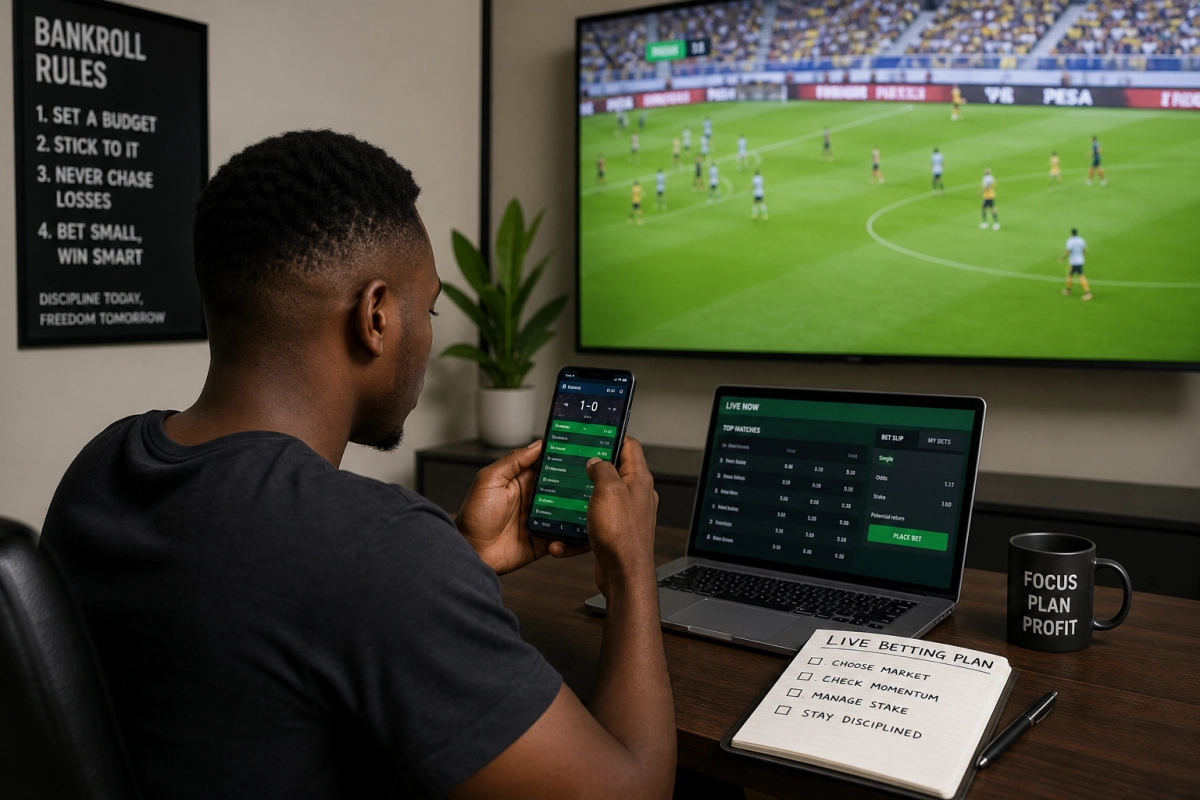
Live betting made practical: what this guide teaches you
This guide explains live betting in football (in-play) and shows how to read the main markets, interpret live statistics and momentum, understand why odds move, and apply concrete bankroll and risk-management rules tailored for bettors in Tanzania and other Swahili-speaking markets. Readers will get clear definitions, practical signs to watch during a match and simple money rules to protect their bankroll. Verify team news and odds before you stake—markets change quickly.
How main in-play markets work (clear definitions for beginners)
Before placing live bets, know each market and what it pays for. These are the markets most commonly used during matches:
- Match winner (1X2) – bets on home win, draw or away win while the game is live. Odds update as events change the probability.
- Over/Under (Total goals) – typically over or under 2.5 goals. In-play you can back over if you expect a late goal surge or under if the match is slowing down.
- Both Teams to Score (BTTS) – yes/no on whether both sides will score. Useful when one team is attacking more but the other creates few chances.
- Asian handicap – evens out differences without a draw outcome for some lines. Live Asian lines move with scoring events and perceived momentum swings.
- Correct score – predicts final score. High risk; in-play prices can offer value after a goal or substitution but require careful judgement.
Advanced markets (corners, bookings, next goal) exist but start with the main five and learn how odds react to match events before expanding.
Interpreting live statistics, momentum and what odds movement implies
Live statistics give immediate clues but must be interpreted together. Focus on a few reliable indicators rather than raw numbers:
- Shots on target and big chances – the best direct indicator that goals are likely soon. Multiple shots on target without goals usually make odds shorten for the attacker.
- Possession swings – long periods of pressure typically favour over-goals or the pressing team to score, but possession alone is not decisive.
- Set-pieces and corners – a high rate of corners suggests sustained pressure and increases value in BTTS or over markets.
- Substitutions and tactics – defensive subs protect a lead; attacking subs signal pursuit of a goal. Note which players enter and their role.
How odds move: bookmakers shorten odds when probability rises (e.g., home team dominates shots and corners) and lengthen when events reduce chances (red cards, injuries). Rapid market shifts can indicate inside information or heavy money on one side—treat sharp movements cautiously and confirm with match footage and reliable live stats.
Bankroll and risk-management rules tailored for Tanzania
Responsible, simple rules help bettors in Tanzania stay in control and enjoy live betting as entertainment:
- Set a dedicated live-betting bankroll separate from other funds. Suggested baseline: 1–5% of bankroll per single live stake.
- Use flat staking for most live bets (same small percentage each time) and reduce stake after two losses in a row.
- Cap the number of live bets per week (for example, 10–15) to avoid fatigue and poor decisions.
- Avoid chasing losses; if you hit a predetermined loss limit for the day, stop and review.
- Keep records: match, market, stake, odds, reason for bet and outcome. Review weekly to learn patterns relevant to local leagues like the Tanzania Premier League.
Next, the guide will show step-by-step match analysis during the first 30–60 minutes: which stats to track minute-by-minute, specific in-play entry points for each market and practical examples you can use while watching a live stream or following text commentary.
First 30–60 minutes: a minute-by-minute checklist for live decision-making
Use the opening hour to build a clear picture before committing larger stakes. Work through this simple timeline while watching a stream or following a reliable match centre:
- 0–15 minutes: watch for early intent. Many teams start cautiously; a high-intensity opening (several shots, two or more corners) suggests the game will open up. If one side shows clear dominance in shots on target and corners, mark them as the likely attacking team for later markets.
- 15–30 minutes: patterns emerge. Track whether chances convert into sustained pressure. Two-plus “big chances” for a team in this window increases the immediate value of backing that side in Asian handicap or next-goal markets—if odds still generous—because probability has risen but the market may lag.
- 30–45 minutes (to half-time): fatigue and tactical shifts begin to matter. Teams protecting a lead often sit deeper and concede possession; this makes under/BTTS lays more reasonable. If the game remains goalless but corners and shots continue, over/BTTS are still live options in the second half.
- 46–60 minutes: substitutions and visible tactical changes are decisive. Attacking substitutes or a manager switching shape (e.g., 4-2-3-1 to 3-4-3) are concrete signals to re-evaluate over/BTTS and Asian handicap exposure. Reduce stake size immediately after a defensive red card or serious injury—these are high-variance moments and markets can overreact.
For bettors in Tanzania who may rely on text commentary, focus on three reliable stats reported quickly: shots on target, corners and named “big chances” or key chances. If those move consistently in one direction, odds will follow; confirm with any available video before increasing stakes.
Practical entry points for each market with short examples
Translate the minute-by-minute read into concrete entry rules for the five main markets. Use small, precise stakes for higher-variance bets.
- Match winner (1X2) – enter when one side has at least a 60–70% share of shots on target over a 15-minute cycle and odds have not shortened fully (value often appears 5–10 minutes after sustained pressure). Suggested stake: 1–2% of bankroll.
- Over/Under – back over 2.5 only after repeated shots on target/corners and attacking subs (common signal: 4+ corners and 3+ shots on target in 25–40 minutes). If goalless late with heavy pressure, over 1.5 can be a safer play. Suggested stake: 1–1.5%.
- BTTS – if both teams create chances and one concedes but continues to attack, BTTS yes often trades shorter quickly; enter early after the goal when odds still fair. Suggested stake: 1–2%.
- Asian handicap – use small sizes (0.5–1%) when a favourite regains control after conceding, or when underdogs sit deep and the market offers +0.5/+1.0 at attractive odds. Avoid complex lines immediately after goals—let the market settle 3–5 minutes.
- Correct score – highest risk. Only use tiny stakes (0.25–0.5%) after clear tactical evidence: a late aggressive substitution plus a favourite dominating corners suggests a 1-1 or 2-1 finish may be plausible; otherwise avoid.
Example: 0–0 at 35′ with home team 6 corners and 4 shots on target in the last 20 minutes — consider a small over/BTTS combo or a home Asian -0.5 once odds reflect the sustained pressure. Always confirm with live footage or trusted text updates and reduce stakes after red cards or sudden market spikes that lack visible justification.
Tech, latency and choosing providers
Live betting depends on fast, reliable information. Streams often lag a few seconds behind bookmakers’ price feeds; expect this and avoid placing impulsive bets the instant a visible event happens. Use reputable operators with low-latency markets, reliable mobile data or Wi‑Fi, and a second source for live stats or text commentary when video isn’t available. For Tanzanian bettors, prefer platforms that support local payment methods and clear customer service in English or Swahili, and always verify market checks (odds, limits, and settlement rules) before staking.
Putting it into practice: final thoughts
Live betting rewards discipline and steady improvement more than bold intuition. Treat each match as a learning opportunity: keep accurate records, limit your exposure, and stick to the simple rules that protect your bankroll. Use small, repeatable actions — consistent stake sizing, short checklists before betting, and pausing after swings — to make better decisions under pressure.
Wherever you are in Tanzania or the wider Swahili-speaking community, combine local knowledge (league rhythms, common tactical patterns) with the universal principles of momentum reading and money management. Stay curious, bet responsibly, and prioritise entertainment and bankroll preservation over quick wins. If betting stops being fun or you struggle to control stakes, seek local support and consider self-exclusion tools offered by operators.