How to Assess Premier League Team News Before Betting
Betting on Premier League matches requires more than comparing recent results or choosing the team with shorter odds. Injuries, suspensions, tactical changes and unexpected rotation can significantly affect a match result, goal totals, both teams to score (BTTS) and player-related markets. A practical assessment should separate confirmed information from predictions and late speculation.
This guide explains how to check team news, interpret predicted line-ups and connect important changes to suitable betting markets. Odds and availability can change before kick-off, so every assessment should be treated as time-sensitive rather than final.
Why Injuries and Suspensions Matter in Premier League Betting
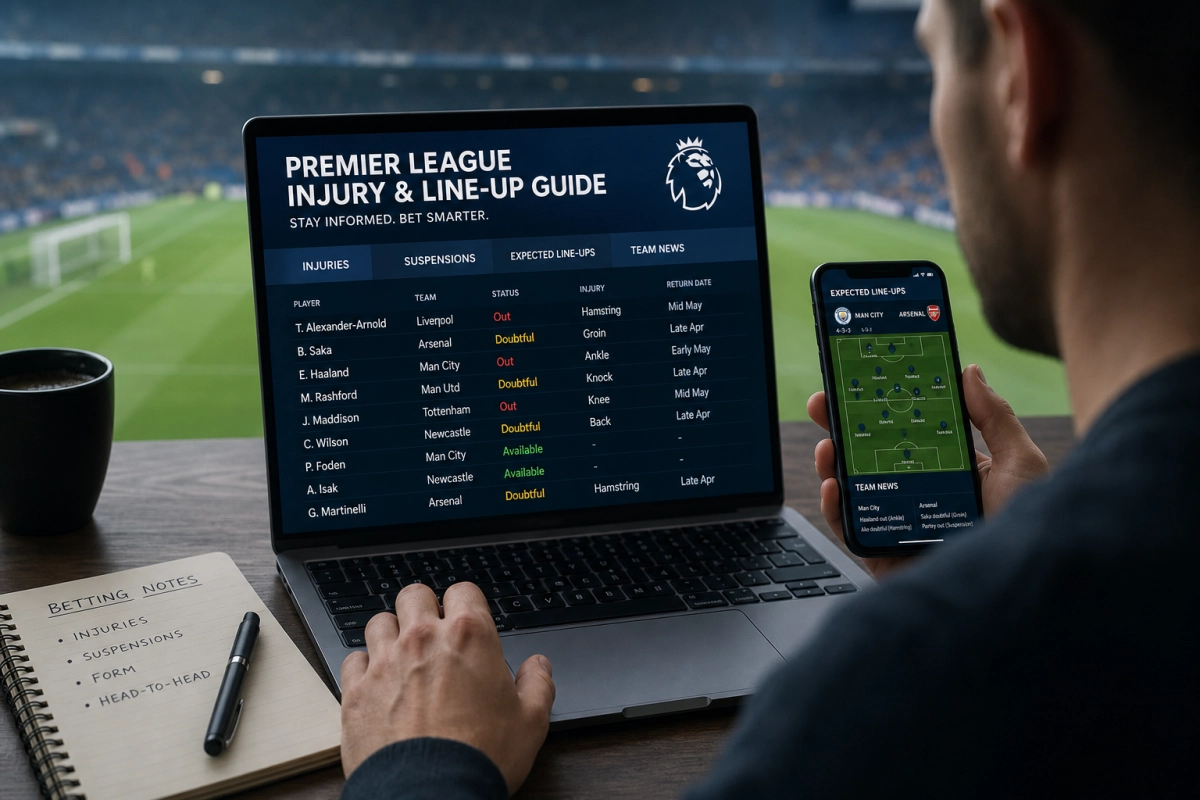
An absence does not always affect a team in the same way. The importance of a missing player depends on the position, tactical role, quality of the replacement and the team’s ability to adapt. A starting centre-back may influence the match result and the opponent’s scoring chances, while a missing striker could be more relevant to total goals or player-prop markets.
Build a team-news checklist
- Confirmed unavailable players: Check official club updates and disciplinary information for injuries or suspensions.
- Doubtful players: A player described as undergoing a late fitness test should not be treated as definitely absent or definitely available.
- Manager comments: Press conferences can provide useful context, but comments may remain deliberately unclear.
- Replacement quality: Assess whether the substitute has similar defensive, creative or attacking characteristics.
- Team structure: Consider whether one absence forces a formation change or moves another player away from his strongest position.
For example, losing a defensive midfielder may expose a back four and increase the opponent’s transition opportunities. The same absence might support a goals market, but it does not automatically mean that the opponent will win. Match style, home advantage and the quality of the replacement still require analysis.
How to Read Predicted Line-Ups and Rotation Risk
Predicted line-ups are useful planning tools, not confirmed team selections. They are generally based on previous starting choices, available squad news, recent minutes, tactical roles and the manager’s rotation habits. A predicted XI should therefore be compared with the team’s last few selections rather than accepted without question.
Fixture congestion is especially important when a club has played in midweek or faces another significant match soon afterwards. Rotation risk may be higher for full-backs, wide attackers and midfielders who have covered heavy minutes. However, managers do not rotate every position equally, and a key player may still start despite a demanding schedule.
A repeatable late-news process
- Record the expected XI and the players listed as doubtful.
- Compare it with recent formations and starting patterns.
- Identify which tactical roles would change if a player is omitted.
- Wait for the official line-up before finalising a pre-match view.
Premier League starting XIs are normally published about 75 minutes before kick-off. The confirmed team sheet can reveal an unexpected benching, formation switch or attacking partnership. The next step is to connect those changes with specific markets and price movements.
How Confirmed Line-Ups Change Match and Goals Markets
Once the official line-ups are released, reassess the original betting view rather than simply confirming it. A team may have the expected personnel but use a different formation, or a regular starter may appear in an unfamiliar role. These details can be more important than the names on the team sheet.
For match-result markets, focus on the balance between the starting XI and the substitutes. A strong bench can reduce the significance of one rotated attacker, particularly if the manager is likely to make early changes. Conversely, a team missing several first-choice defenders may have less protection if the match becomes stretched. The absence of a replacement option can therefore matter as much as the identity of the player left out.
For total-goals and BTTS markets, examine how the confirmed line-ups affect attacking intent and defensive stability. Two natural wingers and an established striker may support a higher-tempo approach, while a conservative midfield selection could reduce the number of clear chances. However, a defensive-looking team can still contribute to an open game if its full-backs push forward or its midfield lacks ball security.
Separate personnel changes from price changes
Team news is only valuable when compared with the odds already available. If the market has moved significantly after reports of an injury, the absence may already be reflected in the price. The relevant question is not whether the player is important, but whether the current odds still underestimate or overestimate the likely effect.
A late change should also be assessed against the original expectation. If a striker was already expected to have limited minutes, his omission may have little additional impact. If a goalkeeper or centre-back is ruled out unexpectedly, the market may need a faster review because defensive organisation and set-piece responsibilities can change immediately.
Assessing Player Bets Through Roles and Minutes
Player-related markets require more than identifying the most talented player in the starting XI. First establish whether the player is likely to complete enough minutes to reach the relevant statistical threshold. A starter returning from injury may be listed in the line-up but still face an early substitution, while a versatile substitute could enter in several different positions.
For goalscorer bets, consider penalty duties, set-piece involvement, expected positioning and the team’s likely attacking route. A forward playing wide may have fewer central opportunities, even if he remains among the team’s best finishers. Similarly, a midfielder promoted into a more advanced role may become more relevant to shots, assists or goal markets than his usual position suggests.
Minutes can also affect cards, tackles and passing markets. A defensive midfielder facing a strong counter-attacking opponent may have increased tackle potential, but an early booking could lead to a cautious performance or substitution. These markets are particularly sensitive to tactical match-ups, so the opponent’s style should be assessed alongside the confirmed XI.
Use Late Information Without Chasing the Market
Late team news can create pressure to place a bet quickly, especially when odds move after the line-ups are announced. Speed is useful, but a rushed decision can lead to betting at a worse price or overlooking a second-order effect. Check whether the change affects the team’s quality, its tactical structure or merely the identity of one player.
Compare several relevant prices where possible and record the reason for any decision. If the evidence is unclear, passing on the market is a valid outcome. Team news improves an assessment only when it is interpreted alongside tactics, expected minutes, opposition quality and the price being offered.
Make Discipline Part of the Betting Process
Reliable Premier League betting decisions are built on patience, context and accurate timing. Team news should sharpen a view, not create pressure to act. Allow enough time to verify the information, consider its tactical consequences and decide whether the available price still justifies a bet.
There will always be uncertainty around late fitness tests, rotation and in-game roles. A disciplined bettor accepts that uncertainty, avoids forcing a selection and treats no bet as a sensible decision when the evidence and price do not align.