
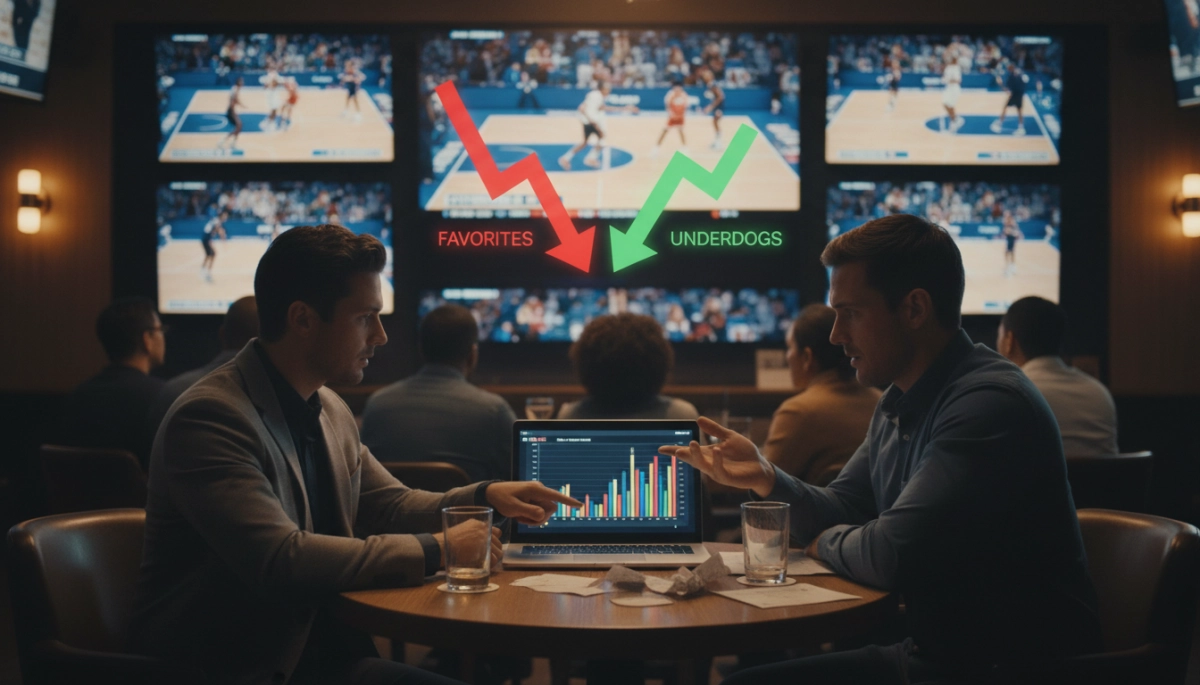
Why you might consider fading favorites on basketball moneylines
Fading a favorite means betting against the team that bookmakers and public opinion expect to win. You don’t do this as a contrarian reflex — you do it when the expected value (EV) and margin for error favor you. In basketball moneyline betting, lines are influenced by injuries, scheduling, back-to-backs, travel, public bias, and market liquidity. When these factors push odds beyond the true probability of an outcome, you have the opportunity to fade the favorite profitably over time.
As a bettor, your goal is to find situations where the market misprices a favorite’s chance to win. Because moneyline payouts are binary (win/lose), small misestimates in implied probability translate into sizeable differences in EV. You should think in percentages and cents: if a favorite’s true win probability is 65% but the market implies 75%, fading that favorite can be rational if you can repeatedly identify similarly mispriced lines.
Key situations where favorites are often overvalued
Not every favorite is a fading opportunity. You want to target specific scenarios where the favorite’s edge is eroded by circumstances that the betting public or oddsmakers underreact to, or where the market overreacts to short-term signals. Below are common situations to watch:
- Back-to-back fatigue: Teams playing the second night of a back-to-back tend to underperform, especially when the first game involved heavy minutes or travel. Public attention often focuses on the favorite’s brand rather than freshness.
- Injury uncertainty: Undisclosed or late scratches to key role players can reduce a favorite’s true win expectancy more than the line reflects, because markets may be slow to fully adjust.
- Public bias toward stars: Popular teams and superstar players attract casual money, inflating prices for favorites beyond objective value, particularly in early-week or national-television games.
- Rest and travel imbalance: A heavily favored home team coming off extended rest versus a road team on a four-game road trip can still be vulnerable, since travel wear and loss of routine hurt away performance more than the public accounts for.
- Line inflated by sharp action: Sometimes sharp bettors move a favorite early, and public money piles on, pushing odds to an irrational level; recognizing when further movement is public-driven is key.
Early-market signals to monitor before fading
Before you commit capital, watch how lines and volumes evolve. Early closing lines that shorten quickly after opening, large shifts without corresponding news, or consensus odds diverging from your model are red flags that might indicate an overvalued favorite. Combine those market signals with game-specific context — rotational depth, coaching tendencies, pace matchup — to build conviction.
In the next part, you’ll get practical rules for quantifying mispricing, specific metrics to monitor in real time, and examples of how to size fades within your bankroll management framework.
Quantifying mispricing: rules and practical thresholds
Turn your qualitative read into a repeatable decision rule. Start by converting moneylines into implied probabilities and compare them to your model or judgmental estimate. Use these quick formulas: for favorites (negative moneyline) implied probability = |ML| / (|ML| + 100); for underdogs (positive moneyline) implied probability = 100 / (ML + 100). The difference between your estimated probability and the market’s implied probability is your raw edge.
Set concrete thresholds to avoid hair-trigger fading. A sensible baseline is to require at least a 4–6 percentage-point gap (e.g., your model gives 65% while the market implies 59–61%). That typically represents enough EV to overcome vig and variance. For larger, less frequent opportunities — eg. when you detect clear injury intel or extreme fatigue — raise the bar to 8–12 points before committing larger stakes.
Translate percentage gaps into expected value to prioritize opportunities. Rough guide: a 5% edge on a -150 favorite (implied ~60%) yields modest EV but can be profitable over volume; a 10% edge becomes meaningfully lucrative. Keep a log of historical fades and their realized ROI so you can empirically refine your thresholds.
Real-time metrics to monitor during pregame and live markets
Markets move for reasons. Track these real-time indicators before executing a fade:
- Line movement vs. volume: Rapid shortening without corresponding form/injury news usually signals public money — potential fade territory. Conversely, large move with thin volume often reflects a sharp — be cautious fading unless your model explicitly disagrees.
- Consensus and closing lines: Compare the market you see to consensus aggregators and the closing line on major books. If one book’s favorite is significantly shorter than consensus and that move coincides with publicity (TV, social buzz), it’s likely public-driven.
- In-play indicators: In live markets, watch in-game shooting variance, foul trouble, and substitutions. A favorite that loses a key role player early can provide high-value live fades before books fully adjust.
- Model confidence score: Assign a confidence metric to each estimate (based on sample size, matchup clarity, injury certainty). Only increase stake when confidence exceeds your baseline.
Sizing fades within a disciplined bankroll framework
Even the best fades lose long streaks; sizing determines survival. Two pragmatic approaches work for most bettors:
- Flat-unit staking: Bet a fixed small percentage of bankroll per qualifying fade (commonly 1–2%). This reduces emotional tilt and is simple to scale.
- Fractional Kelly: If you calculate an edge, use a conservative Kelly fraction (10–25% of full Kelly). For example, a 5% edge might suggest a tiny Kelly fraction — cap it to a maximum single-bet exposure (3–5% of bankroll) to avoid catastrophic drawdowns.
Also set aggregate limits: cap total exposure to multiple fades on the same slate (eg. no more than 10% of bankroll across all simultaneous fades) and enforce maximum consecutive-bet rules (pause after three straight losses to reassess model inputs). Discipline in sizing — not perfect forecasting — is what turns selective fading into a long-term edge.
Pregame checklist before you fade
- Confirm a minimum edge threshold (eg. ≥5%) after converting moneyline to implied probability and comparing to your model.
- Check injury reports and lineup confirmations within one hour of tip — unresolved scratches reduce confidence.
- Verify line movement source: public-driven shortening is a better fade signal than a sharp move supported by volume.
- Ensure bankroll sizing rules allow the stake (flat units or fractional Kelly) and that aggregate exposure limits are respected.
- Record the rationale in your log (edge, confidence, market signal) so results can be audited and thresholds refined.
Quick rules for live-market fades
- Act fast when a favorite loses a rotation player early — before books fully reprice — but only if your live-read model supports the change.
- Avoid chasing runs; look for structural shifts (foul trouble, major lineup change) rather than temporary variance.
- Use smaller stakes than pregame if your live confidence score is lower; volatility in-play is higher and lines can move quickly.
Putting fades into practice
Fading favorites is a repeatable strategy when executed with rules, records, and restraint. Treat fades as one tool in your broader approach: apply objective thresholds, size bets conservatively, and let a disciplined process — not short-term outcomes — guide you. Keep a detailed log, review results regularly, and adjust your edge criteria rather than your stake after a few losses. For deeper reading on market behavior and staking strategies, visit Pinnacle Betting Resources.