
How to Evaluate Serie A Betting Opportunities
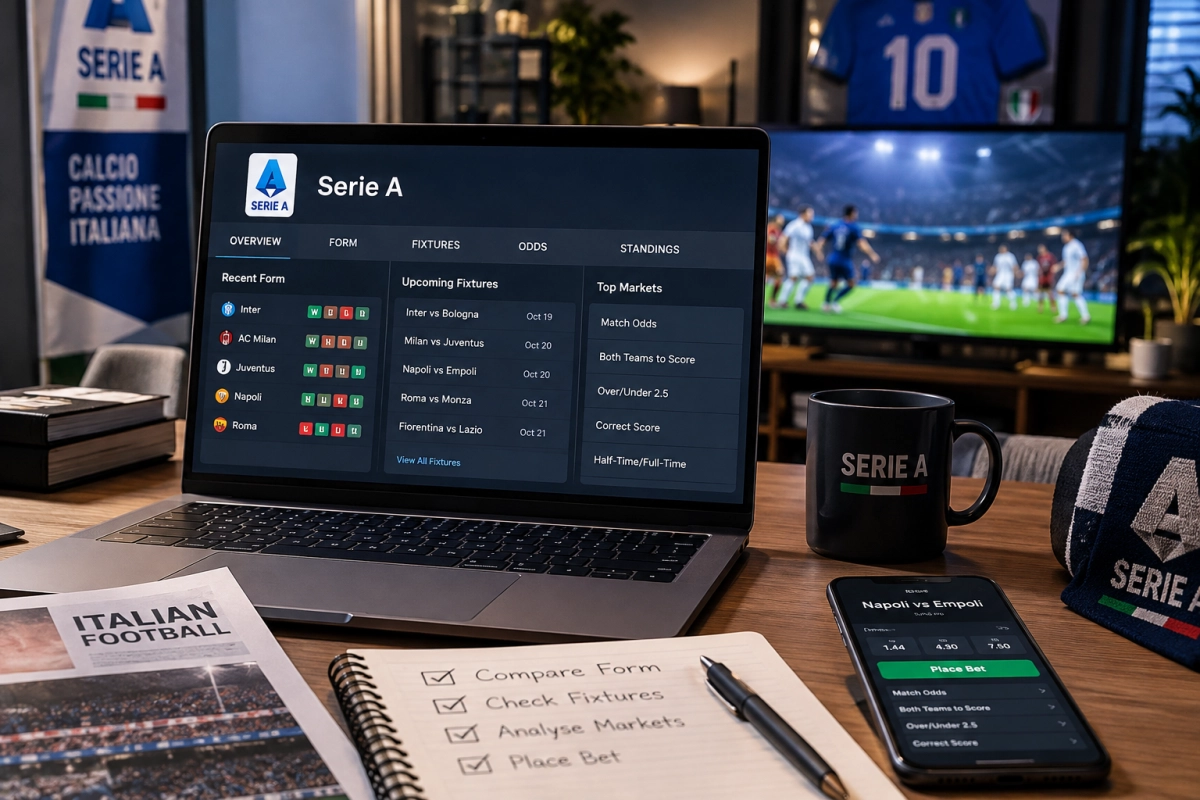
Serie A betting becomes more structured when you compare the match schedule, home and away records, recent form and available odds before choosing a market. Instead of backing a familiar club automatically, you can assess whether the fixture supports a match winner, double chance or draw no bet selection. This guide explains a practical process for evaluating matches, while recognising that team news, prices and circumstances can change before kickoff.
Start with the Fixture, Schedule and Match Context
Before studying a team’s last five results, examine the fixture itself. Ask where the match sits in the calendar and what each club has recently played. A team involved in European competition may have limited recovery time, particularly during busy periods when matches are scheduled twice in one week. Travel, extra-time matches and rotation can affect energy levels and expected line-ups.
- Check the previous match: Note the opponent’s quality, the result and whether key players completed the game.
- Review the next fixture: A club facing an important European or domestic match soon afterwards may rotate its squad.
- Assess rest days: A short recovery period can matter more for pressing teams and older squads.
- Consider motivation: Champions League qualification, survival, a cup tie or a local rivalry may influence intensity.
Motivation should not be treated as a guaranteed explanation for a result. Use it alongside confirmed team news, tactical tendencies and the quality of the opposition. Also check whether a manager has recently changed. A new coach may alter formation, defensive structure or player selection, making older statistics less reliable.
Compare Home and Away Records Properly
Overall league form can hide an important difference between performances at home and away. A club may be strong in its own stadium but less effective when travelling, while another may collect points through disciplined away defending. For this reason, compare the home record of the host with the away record of the visitor rather than relying only on the league table.
Useful indicators include:
- Wins, draws and defeats in the relevant home or away split
- Goals scored and conceded in those matches
- Clean sheets and matches in which the team conceded first
- Performance against clubs of a similar level
- Recent changes in formation, injuries or starting personnel
For example, a high-ranked home side may look attractive in the match-winner market, but frequent draws against organised visitors could make double chance or draw no bet more suitable. Double chance covers two outcomes: home win or draw, away win or draw, or either team winning. Draw no bet applies to one team and refunds the stake if the match ends level, although the odds are usually lower than a standard win selection.
Match Winner, Double Chance or Draw No Bet?
Use the market that best reflects your assessment and the uncertainty surrounding the fixture. A match winner offers a higher potential return but requires one exact result. Double chance provides wider outcome coverage, while draw no bet removes the draw as a losing result but does not protect against defeat.
Next, examine fixture congestion, injuries and price differences before deciding whether the available odds fairly reflect the evidence.
Measure Fixture Congestion Beyond the Number of Matches
Two matches in seven days do not affect every team in the same way. Consider the intensity of the previous fixture, the amount of travel involved and whether the manager has enough reliable substitutes. A deep squad may cope with a crowded schedule, while a team dependent on a small group of starters can lose effectiveness when those players are rested or carry minor injuries.
Look for signs that congestion could influence the market:
- Several starters played the full previous match or required treatment
- The team had to travel after a demanding European or cup fixture
- The next match is viewed as more important by the manager or supporters
- Suspensions or injuries affect the goalkeeper, centre-backs or main striker
- Recent performances showed a drop in pressing, running or concentration
Do not assume rotation automatically makes a team a bad bet. A rested replacement may fit the tactical plan better than an unavailable regular, and some clubs manage minutes carefully. Confirm the likely line-up close to kickoff and distinguish between a missing star attacker and an absent defender. Their effects on the match may be different: one can reduce scoring potential, while the other may increase the opponent’s chance of finding the net.
Use Team News and Motivation to Adjust the Initial View
Once the schedule and split records point towards a possible selection, test that view against current team information. A home advantage statistic from earlier in the season may be less useful if the club has changed coach, lost its first-choice full-backs or altered its attacking system. Similarly, a strong away record may have been built against weaker opponents and may not transfer to a match against a high-quality home side.
Motivation is most useful when it is specific and visible. A team competing for a European place may approach a direct rival differently from a mid-table club with little at stake, but league position alone does not prove that one side will perform better. Check whether the club has another important match approaching, whether the manager has discussed rotation and whether recent selections support the expected level of commitment.
It is also worth separating motivation from pressure. A relegation-threatened side may show urgency, yet pressure can produce cautious football, poor decision-making or an unwillingness to take risks. This can make a draw more plausible and support a double chance or draw no bet approach rather than a confident match-winner selection.
Compare the Odds With the Risk of Each Market
The final step is to compare your assessment with the available price, not simply choose the outcome that appears most likely. A short home-win price may offer little value if the visitor has a strong away defence and the host is rotating after a European match. In that situation, home draw no bet could provide a more balanced way to support the stronger side, while double chance may be appropriate if the draw appears especially credible.
Record the odds from more than one bookmaker where possible and check whether the market has moved after team news. Avoid treating a price change as proof that a selection is correct. Instead, ask what information may have caused it and whether that information is already reflected in the current odds. A disciplined decision should include the predicted result, the main risks, the selected market and the minimum price at which the bet remains attractive.
Build a Consistent Serie A Betting Process
The strongest betting decisions come from a repeatable process rather than a single statistic or an instinctive preference for a well-known club. Treat every selection as a price-sensitive judgement, remain willing to change your view when line-ups or circumstances change, and avoid forcing a bet when the available odds do not justify the risk.
Keeping a record of your assessments and results can also reveal whether your approach is genuinely effective over time. Bet only within a defined budget, accept that uncertainty cannot be removed from football, and regard passing on a fixture as a disciplined decision when no market offers sufficient value.