
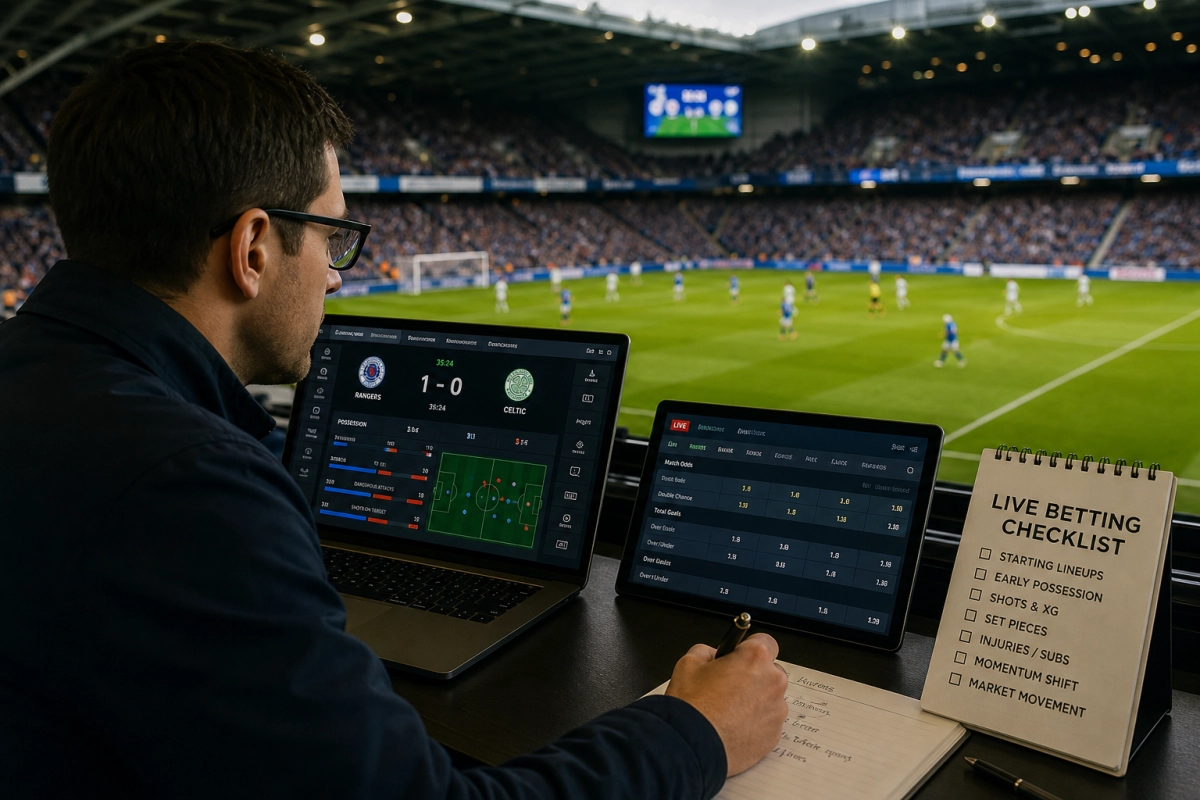
Reading the match state: the first step to sensible live betting
This guide teaches bettors how to choose live betting markets and stake sizes by reading the match state: scoreline, minutes remaining, team urgency, substitutions, cards and schedule. It explains what match-state signals mean, which markets suit each situation, and how to protect a bankroll with simple stake rules. The advice is evergreen and meant to help readers make clearer, responsible in-play decisions without promising guaranteed wins.
What “match state” includes and why it matters
“Match state” is the snapshot of a game at any moment. Key components are:
- Scoreline — who is winning or if it’s level. Determines urgency and likely tactics.
- Minutes remaining — early, middle or late game strongly changes probabilities.
- Team urgency and motivation — relegation battles, cup ties or fixture congestion affect risk-taking.
- Substitutions — fresh attackers or defensive changes shift momentum.
- Cards and suspensions — a red card reduces defensive options; yellow-card accumulation may change fouling behavior.
- Schedule and travel — tired teams late in a season or after long travel often lose sharpness.
Reading these elements gives bettors context for choosing markets such as match winner, draw no bet, over/under goals, both teams to score (BTTS), Asian handicap, or correct score during live betting.
Quick definitions for common live markets
- Match winner / 1X2 — which team wins from now until final whistle.
- Draw no bet — backs a winner but refunds if the match ends level.
- Asian handicap — evens perceived strength differences by giving goals handicap.
- Over/Under (goals) — will total goals in the remainder exceed a line (e.g. 0.5, 1.5).
- Both teams to score (BTTS) — whether both sides will score at any time before full-time.
- Correct score — predicts the final scoreline; high-risk in-play pick.
Pre-live and in-play checklists every bettor should use
Before placing any live bet, run this short checklist. It keeps decisions structured and reduces impulsive wagers.
- Confirm line-ups — missing key striker or keeper changes the market.
- Check schedule — is one team on a busy run of fixtures or travelling?
- Assess motivation — is the match decisive for league position or rotation?
- Set a stake limit — decide stake size before entering the market (see simple rules below).
- Monitor live indicators — possession trends, shots on target, and expected goals (xG) updates.
Simple phase-based signals for market selection (overview)
- Early game (0–30 minutes) — favour markets that expect low volatility: match winner or small Asian handicap if teams are settled.
- Middle game (31–60 minutes) — watch substitutions and momentum; over/under and BTTS can change quickly.
- Late game (61 minutes onward) — scoreline and minutes remaining drive urgency; late goals or a sending-off often open value on markets like next-goal or adjusted handicaps.
Next, the guide will provide detailed phase-by-phase decision rules, example checklists for substitutions and card events, and clear stake-sizing templates suitable for conservative and moderate bettors.
Phase-by-phase decision rules (detailed)
Turn the overview into a short decision flow you can run through quickly while watching. Use minutes remaining, scoreline and team urgency as the top three inputs — then apply the rules below to choose markets and approximate stake sizes.
- Early game (0–30 minutes)
- If teams are level and both starting strong, prefer low-volatility markets: small Asian handicap (±0.25/0.5) or match-winner on the stronger side.
- If a key starter is missing or an early injury/substitution happens, pause for 2–5 minutes to see tactical adjustment before betting.
- Stake guidance: conservative bettors keep live stakes ≤0.5 unit; moderate bettors up to 1 unit, only if odds reflect clear value (implied probability noticeably lower than your read).
- Middle game (31–60 minutes)
- This is a tactical window. Substitutions by either manager often signal a change of intent — first-sub attacker on = consider over/under 0.5 or BTTS; defensive sub = consider Asian handicap favoring the subbed-on defender’s side.
- If one side dominates possession and shots but hasn’t scored, markets like “next goal” or over 0.5/1.5 of the remainder can be sensible at favourable odds.
- Stake guidance: scale into momentum. Start small (0.5 unit), add a second equal stake only if clear momentum continues for 8–12 minutes.
- Late game split (61–80 minutes vs 81+ minutes)
- 61–80 minutes: tactical urgency grows. A trailing team will often open up; mid-priced over/under and BTTS markets can offer value. Consider Asian handicaps that reflect one-goal swings.
- 81 minutes onward: time is decisive. If a team is chasing, next-goal and small handicaps are high-variance but sometimes the only realistic value plays. If a team leads and sits deep, favour low-volatility markets (defend-the-lead bets, match-winner for leading team) or avoid betting when odds compress.
- Stake guidance: conservative bettors cap single-stake to 0.5 unit after 80’; moderate bettors can go up to 1–2 units for clear, urgent scenarios (e.g., trailing team with major attacking substitution and high xG pressure), but set a firm per-match loss limit.
Substitutions, cards and momentum: event checklists
Specific events change the match state instantly. Use these quick checklists to translate an event into market action.
- Attacking substitution by trailing team
- Minute: when? (early 2nd half vs 80+ matters)
- Who on/off: striker for midfielder = increased chance of goals; full-back off for forward = defensive risk
- Market actions: consider next-goal, over 0.5 remaining, or handicap favouring the attacker’s side. Size stakes smaller if substitution occurred after 80′.
- Defensive substitution by leading team
- Check formation change and whether the sub is a specialist (e.g., defensive midfielder).
- Market actions: reduce exposure to over/under and BTTS; consider match-winner for defending team or Asian handicap protecting lead.
- Yellow accumulation or red card
- Yellow cards: multiple yellows can indicate a team will foul less or more depending on context — watch for tactical fouling or deliberate caution.
- Red card: always re-run the match-state checklist — minute, scoreline and which player sent off. A red for the leading team late greatly increases value on opposing next-goal and match-winner bets.
- Market actions: after a red, momentum often swings immediately. Wait 1–2 minutes to see shape before committing more than a conservative stake.
- Injury or goalkeeper change
- Goalkeeper change hugely impacts probability of goals; even a late injury can be worth reducing stakes on defensive bets and increasing on opponent’s shot markets.
Always pair event-driven choices with a pre-set stake cap and a per-match loss limit. Quick reaction is useful; disciplined sizing prevents a single swing turning into a bankroll setback.
Simple stake-sizing templates for responsible live betting
Use these templates as your starting point. Define a unit size (e.g., 1 unit = 1% of bankroll for conservative, 2% for moderate) and stick to the caps below.
- Conservative template
- Unit = 1% bankroll.
- Max single live stake = 0.5–1 unit depending on confidence.
- Max exposure per match (all live bets combined) = 2 units.
- Session stop-loss = 3–5% bankroll.
- Moderate template
- Unit = 2% bankroll.
- Max single live stake = 1–2 units (higher only in strong, clear match-state edges).
- Max exposure per match = 4 units.
- Session stop-loss = 6–8% bankroll.
Final rule: set these numbers before you start watching and treat them as non-negotiable. The match state offers edges — but only disciplined sizing converts edges into long-term sustainability.
Practice plan: build match-state instincts
Turn theory into habit with focused practice that keeps risk low while you learn to read match states faster.
- Paper-trade for 7–30 sessions: place simulated live bets (or use minimal stakes) on a single league to control variability.
- Limit scope: pick one market (e.g., next-goal or over/under) and one time window per session to simplify decisions.
- Keep a short journal for each decision: minute, scoreline, event (sub/card), market chosen, stake, odds, outcome, and one sentence on why you acted.
- Review weekly: track ROI, hit rate and largest variance events. Look for patterns in where you consistently misread urgency or momentum.
- Gradually scale: only increase live stakes after a consistent, documented improvement in decision quality; keep unit size fixed as a percentage of bankroll.
Putting it into practice
Live betting sharpens when structure meets restraint. Use your checklists, practice deliberately, and let measured experience—not impulse—guide stake changes. Protect the bankroll, treat losing stretches as data, and keep betting within limits that preserve enjoyment and wellbeing. If betting ceases to be fun or becomes compulsive, step back and seek support. The goal is a steady, disciplined approach that lets you act on clear match-state signals while avoiding costly, emotion-driven choices.