How to find value when Betting on Premier league: markets explained and a pre-match routine
Betting on Premier league requires clear rules and a repeatable routine. This first part explains the main markets (match result, BTTS, over/under, Asian handicap and common props), defines key terms and provides a compact, reusable pre-match checklist plus a simple odds-comparison routine that bettors in Tanzania and other Swahili-speaking markets can apply before kickoff.
Core markets and quick definitions every bettor should know
Before searching for value, the reader must understand what each market offers. Short definitions keep analysis consistent.
Match result (1X2) and double chance
Match result (1X2) is the straight market: home win, draw or away win. Double chance covers two outcomes (home or draw, draw or away, home or away) and lowers odds while reducing risk.
Both Teams To Score (BTTS)
BTTS is a yes/no market: will both teams score during 90 minutes? Useful when teams have clear attacking/defensive profiles but limited knockout implications.
Over/Under goals
Over/Under (usually 2.5) bets whether total goals exceed the line. Lower lines (1.5) or higher lines (3.5) suit different match paces and tactical expectations.
Asian handicap
Asian handicap evens perceived mismatches by adding or subtracting fractional goals from a team’s score. It removes the draw in many lines and can protect part of a stake on a push.
Common prop markets
Popular props include anytime scorer, correct score, total corners and card counts. Props are valuable when team news or tactics create specific, detectable advantages.
Reusable pre-match checklist and a simple odds‑comparison routine
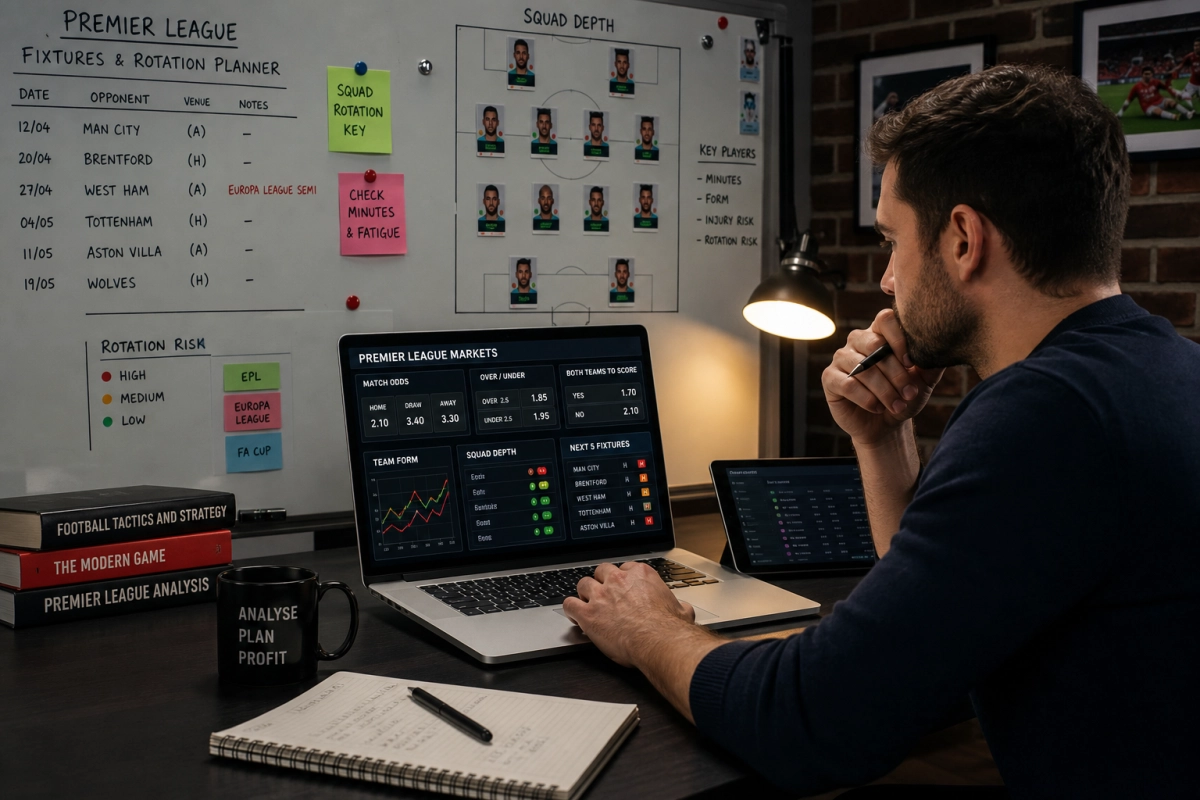
A short, consistent checklist helps strip emotion and focus on measurable value. Use this before every Premier League match you analyse.
- Confirm basics: kickoff time, venue, confirmed line-ups (when available) and referee assignment.
- Recent form: last 5–8 matches for each team and separate home/away splits.
- Tactical profile: expected formation, pressing intensity, set-piece strength and likelihood of open play.
- Availability: injuries, suspensions and late fitness doubts — treat anything unconfirmed as possible but not certain.
- Schedule and motivation: fixture congestion, travel, cup commitments and league position pressure.
- Head-to-head trends: styles matchups and goal tendencies over recent meetings (avoid over-weighting ancient results).
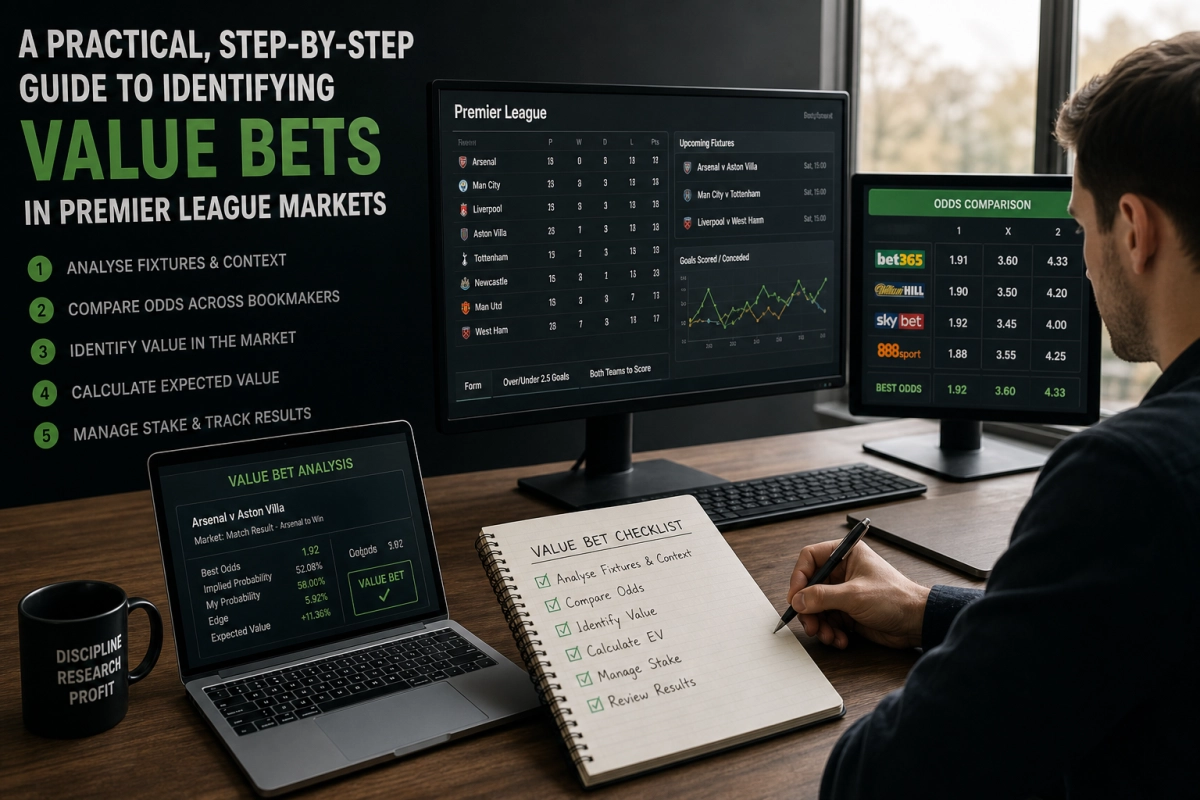
- Market baseline: record the best available odds for primary markets across 2–3 bookmakers or exchanges.
Odds-comparison routine (3 quick steps):
- Collect decimal odds for the same market from multiple sites or the exchange.
- Convert each odd to implied probability (1 / decimal odd) and compare with your subjective probability based on checklist factors.
- Flag bets where your probability exceeds the market’s implied probability by a margin you are comfortable with (e.g. 5–10% relative edge).
Always verify latest team news close to kickoff and remember responsible betting: set a clear stake plan, never chase losses and bet only if you are of legal gambling age. The next part will show how to convert observations into numeric probabilities, calculate value, and read market movements before kickoff.
Turning observations into probabilities and calculating value
You’ve collected facts from the checklist — now translate them into numbers you can compare to the market. The simplest, reliable routine is three steps:
- Produce a subjective probability for the market. For binary markets (BTTS, over/under, most props) give a single probability (e.g. BTTS = 0.62). For 1X2, assign probabilities to the three outcomes (e.g. Home 0.45 / Draw 0.25 / Away 0.30). Keep notes explaining why (form, injuries, scheduling, tactical matchup).
- Convert bookmaker odds to implied probabilities and remove the bookmaker margin. For each available decimal odd do 1 / odd. Sum those implied probabilities to get the market overround. Normalize: fair_prob = implied_prob / sum(implied_probs). Example for 1X2: odds 2.50, 3.60, 2.90 → implied 0.400, 0.278, 0.345 → sum 1.023 → fair probabilities ≈ 0.391, 0.272, 0.337.
- Calculate value. Two practical ways: relative edge and expected value (EV). Relative edge = (your_prob – market_prob) / market_prob. EV (per unit staked) = (decimal_odd × your_prob) − 1. Positive EV indicates value. Using the example above, if your subjective Home probability is 0.45 and the fair market prob is 0.391, EV = 2.50 × 0.45 − 1 = 0.125 (12.5% positive EV).
Practical rules: require a minimum edge (e.g. 5–10%) before staking. For low-liquidity props or exchange lay bets, demand a larger edge because market inefficiencies are riskier. Record the rationale and your edge so you can review outcomes and calibrate your probability estimates over time.
Reading market movements, liquidity signals and late news
Market movement is information — but you must interpret it. Ask three questions whenever odds change materially between your first scan and kickoff:
- Is there a confirmed news catalyst? Line-up changes, injuries, referee switch or weather justify big moves. If a favourite loses a key starter, lengthening odds make sense and should change your subjective probabilities.
- Is the movement volume-driven or thin-market noise? On exchanges, look at matched amounts and the back/lay spread. Large matched volume and narrowing spreads usually signal smart money (sharps); small volume with wide spreads is noise and riskier to follow.
- Are movements consistent across bookmakers? When several books shorten the same outcome it’s often informational. When only one book moves (promotions, liability), treat it skeptically.
Common patterns and how to act:
- Shortening without news: usually sharp money. Re-examine your model quickly — if you still believe in your number and edge remains after recomputing, consider taking the bet (or a reduced stake) early.
- Lengthening after negative news: update probabilities and don’t force the original bet. Loss of a key attacker or heavy travel fatigue often removes value for over/BTTS lines.
- Late heavy movement on props: these are frequently soft markets where bookmakers react to syndicate activity. Only act if you can identify why and quantify the impact.
Finally, always respect correlation: a late change that affects match result likely impacts BTTS, over/under and goal-scorer props. Recalculate linked market probabilities rather than treating each independently. Keep documenting movements and outcomes — that record is how you learn to distinguish noise from genuine information advantage.
Putting the process into regular practice
Turning analysis into consistent results is mostly about routine, record-keeping and honest feedback. Treat every pre-match scan, odds comparison and market move as data you can learn from rather than a one-off gamble. Discipline in execution — not cleverness in a single pick — separates repeatable advantage from luck.
Practical next steps
- Start small: use low stakes or paper-trade while you build the habit of completing the checklist and calculating edges.
- Keep a compact log for every selection: date, fixture, market, stake, decimal odds, implied market probability, your probability, calculated edge, rationale and final outcome.
- Review weekly: check calibration (how often your probabilities occur), ROI by market type and whether particular checklist items reliably predict outcomes.
- Set simple staking rules: fixed units, percentage of bankroll or a conservative Kelly fraction. Pre-define maximum daily/weekly loss limits and stick to them.
- Calibrate thresholds: require a minimum relative edge for each market type and raise that bar for thin or promotional markets.
- Paper-test changes: if you alter how you estimate probabilities or how you react to market movement, run a trial before committing larger stakes.
Behavioral rules to protect your progress
- Avoid chasing losses or increasing stakes after emotional swings — pause and review rather than escalate.
- Record context: note fatigue, distractions or alcohol that might have influenced a decision; these patterns matter over time.
- Respect liquidity: be cautious with large stakes in low-volume props or exchange markets with thin matched amounts.
- Keep learning: treat losses as diagnostic information, not failure. Iterate your checklist and probability model from real outcomes.
- Bet responsibly: only wager what you can afford to lose and follow legal and age requirements in your jurisdiction.
Adopt the routine, protect your bankroll and let objective records guide your improvements — consistency and honest review are the practical edges you can control.