
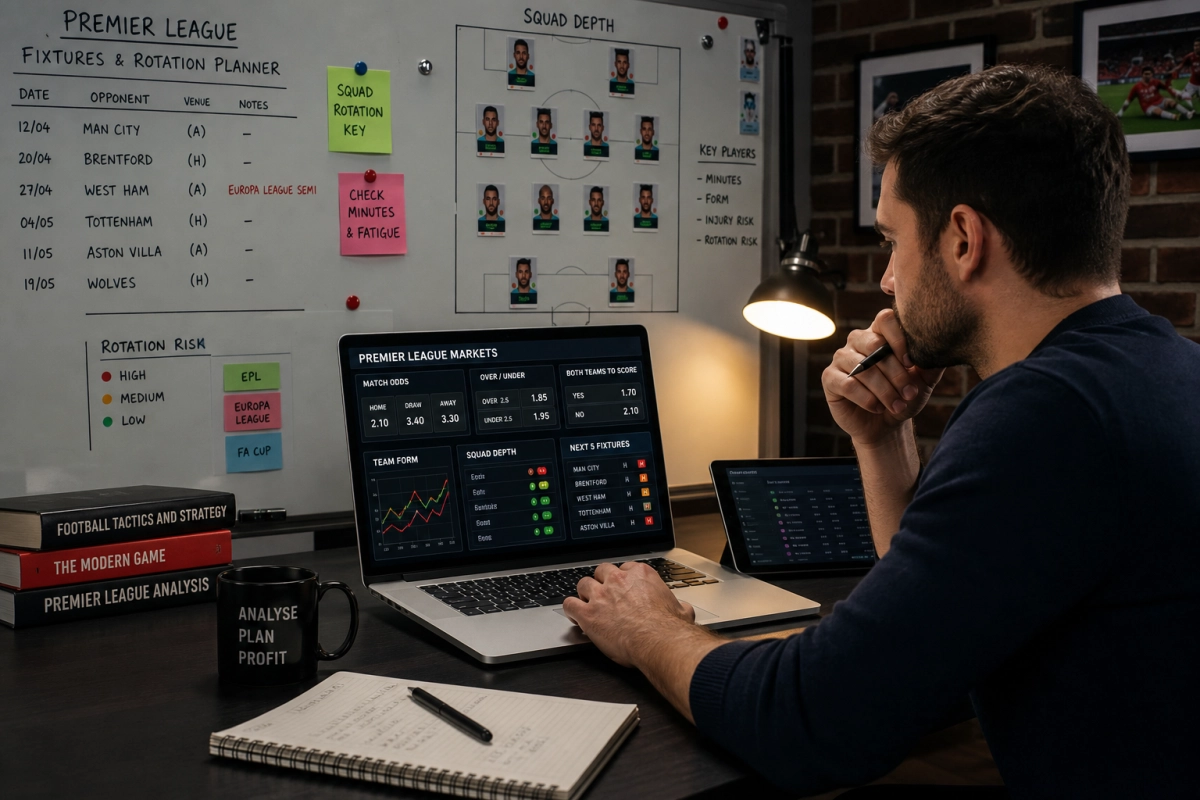
Read the schedule first: what Betting on Premier league requires before you open the markets
This guide explains how to turn fixture lists, squad depth and travel plans into clear pre‑match choices for popular markets: match winner, draw no bet (DNB), both teams to score (BTTS), over/under goals and Asian handicap. Readers will learn what to check on the calendar, how rotation risk affects probability, and simple ways to size stakes responsibly. Always verify line‑ups and official team news before placing a bet.
Quick definitions of common markets to use with schedule analysis
Before analysing schedules, here are short, practical definitions so terms remain clear:
- Match winner – three-way result: home win, draw, away win.
- Draw No Bet (DNB) – you back a team; stake returned if the match draws. Useful when draw risk is high.
- Both Teams To Score (BTTS) – yes/no market on whether both sides will score at least once.
- Over/Under goals – common lines are 2.5 or 3.5 goals; pick if total goals will be above or below the line.
- Asian handicap – evens out strength differences by giving a virtual goal advantage or deficit; halves or quarters reduce draw outcomes.
How fixture congestion, travel and cup commitments shape market choice
Fixture congestion and travel directly affect team selection, intensity and defensive focus. The basic rule: the busier and farther the trip, the higher the chance of rotation and conservative tactics.
- Back‑to‑back matches – if a team plays three matches in seven days, expect rotation. That reduces attacking cohesion and can lower over/under expectations; DNB on the fresher opponent is often preferable.
- European or cup commitments – when a club has a midweek European tie or cup replay, managers commonly rest key starters in the next Premier League fixture. This raises the value of conservative markets (DNB, draw, under 2.5) or smaller stakes.
- Long travel – long flights or late returns increase fatigue risk. Away teams on long trips may sit deeper, lowering BTTS and over markets and increasing the appeal of Asian handicap for the home side if the road side fields a weakened squad.
- Motivation and rotation signals – relegation battles, top‑four races or cup finals change rotation logic: managers may prioritise one competition and rotate more heavily elsewhere. Always check club statements and expected line‑ups.
Practical checklist to scan the schedule in under five minutes
- Count matches in last 10 days for each team (league + cups + Europe).
- Note any midweek long‑distance travel or late kickoffs.
- Identify which competition a manager is likely prioritising (use public comments, form and squad depth as clues).
- Check for international breaks or recent return from international duty; players may be rested or unavailable.
- Decide which market fits the context: rotate risk → DNB or under; full‑strength sides and open tactics → BTTS or over 2.5; one side weakened → Asian handicap or match winner with caution.
These schedule checks reduce surprises and help select markets that reflect expected team selection and tactics. The next section applies squad depth and known rotation patterns to identify concrete market choices and sensible stake sizes based on risk level.
Assess squad depth by position — who gets rested and how that shifts markets
Rotation is rarely random: managers most often rest creative midfielders and forwards, or rotate full‑backs and holding midfielders when protecting a lead across competitions. Use a quick position‑by‑position lens to translate likely changes into market consequences.
– Goalkeeper/central defence: rotation here is less common unless injury/fixture madness. If a backup keeper starts, expect conservative tactics and fewer goals conceded; this increases the appeal of under 2.5 and DNB on the opposition.
– Full‑backs/wingers: fresh wingers often drive BTTS and over markets. If a team is resting wingers (or the opponent’s wingers are absent), downgrade BTTS and over 2.5 probability; consider under or handicap on the team that kept its wide attackers.
– Central midfield/creativity: losing a playmaker reduces expected chances and transition goals. That maps to under 2.5 or Asian handicap favoring the opponent if they remain full‑strength.
– Striker rotation: absence of a leading striker can kill a favourite’s match‑winner value. If a top scorer is rested, prefer DNB on the opponent or smaller stakes on match‑winner.
– Bench quality matters: a team that habitually rests starters but replaces them with international‑level backups (deep squad) offsets rotation risk. If bench quality is high, stick with usual markets (BTTS/over); if bench is thin, move to conservative options.
Practical steps: scan recent lineups to see who is regularly rotated, check minutes logged by key players over the last 7–10 days, and mark positions where the backup materially reduces attacking output. That informs whether to tilt toward DNB/under or remain aggressive with BTTS/over.
Turning schedule and squad reads into precise market choices
Match different schedule-squad scenarios to market templates — clear, repeatable rules save emotional mistakes.
– Busy schedule + thin bench (away or home): favour DNB on fresher side or under 2.5. Stake small to medium.
– Busy schedule + deep bench (big club): markets remain open — consider Asian handicap to capture quality gap, or BTTS if both sides rotate attackers.
– One side severely weakened (key striker or playmaker absent): back the unaffected side on match‑winner or -0.5 Asian handicap; if draw risk is high, prefer DNB instead of straight win.
– Both sides likely to rotate heavily: aim for low‑variance plays — under 2.5, BTTS no, or small DNB stakes if one side still slightly stronger.
– Late lineup confirmation (1–3 hours before kick‑off): use small, informed stakes. Lineup leaks often change market prices; if a late confirmed weakened XI appears, be ready to increase stake modestly only when value is clear.
Stake sizing rules based on rotation uncertainty and market type
Translate confidence into units, not emotion. Use three tiered risk classes tied to schedule and squad reads:
– Conservative (low uncertainty — clear bench depth or starters confirmed): 2–3% of bankroll per bet. Suitable for DNB, Asian handicap with clear quality gap, or match‑winner when rotation risk is low.
– Standard (moderate uncertainty — some rotation likely but not decisive): 1–1.5% of bankroll. Use for BTTS/over 2.5 when attackers might rotate, or when one key player is doubtful.
– Speculative (high uncertainty — late lineups, heavy rotation or cup priority): 0.5% or less. Use for match‑winner punts, risky Asian handicaps, or long‑odds value created by unexpected selections.
If you use proportional staking (Kelly), downsize the full Kelly by 50–75% in rotation-heavy fixtures to avoid volatility. Always set a daily/weekly loss limit to prevent chasing when schedules surprise you.
Last‑minute pre‑match checklist (0–120 minutes before kick‑off)
- Confirm official starting lineups and any late injuries or suspensions.
- Re‑check travel or weather reports that could alter tactics (heavy rain, strong wind).
- Monitor odds movement for sudden value shifts caused by late team news.
- Decide final stake size and set a stop‑loss if markets move against you quickly.
- If uncertainty spikes (unexpected rotation, key player late withdrawal), reduce stake or skip the market.
Simple recordkeeping habit
Before you place the bet, note one sentence on why you made the play (schedule factor + squad read + chosen market). Track outcome and any key lineup/tactical information that proved decisive — small records compound into clearer edges over time.
Final tips for disciplined pre‑match decisions
Betting off schedules and squad reads rewards process more than intuition. Be patient: wait for reliable signals, size stakes to the level of uncertainty, and protect your bankroll when rotation and late news make outcomes less predictable. Use the calendar to narrow markets quickly, but let confirmed lineups and odds guide final choices. Over the long run, discipline, simple recordkeeping and adapting stakes to the clarity of information are the most consistent advantages a bettor can build.