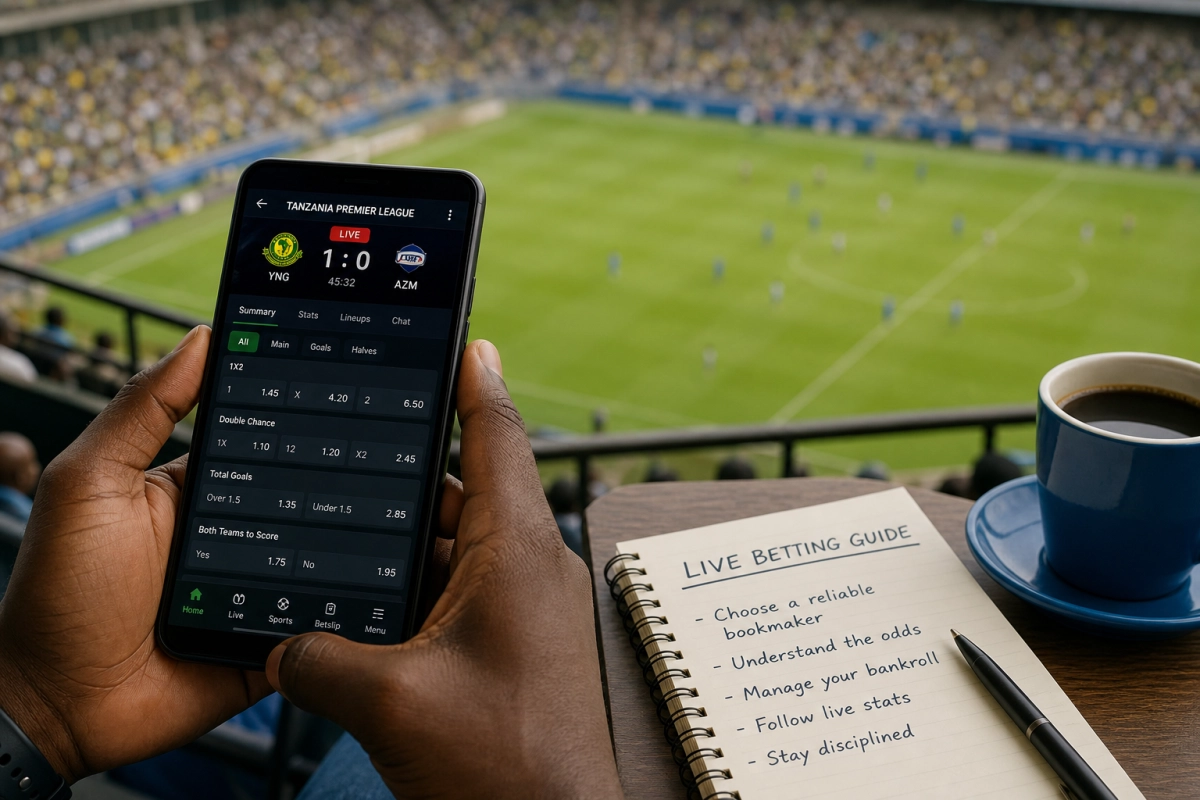

How to use live betting to read a match: a practical, match-centred approach
This guide teaches clear, practical steps for live betting during African and international matches. It explains what to watch on the pitch, defines core in-play markets (over/under, both teams to score, Asian handicap, two chances) and shows how to translate live observations — team shape, momentum shifts, substitutions and statistical triggers — into market choices. Readers will learn to assess situations, compare available markets and manage risk responsibly while avoiding promises of guaranteed returns.
What this guide covers and how to follow it during a live match
Designed for beginners and regular bettors in Tanzania and neighbouring Swahili-speaking markets, the guide is match-centred: start by observing the match, then match observations to markets. The key steps are:
- Understand the in-play market you plan to use (definition and typical price movement).
- Read the current match phase (opening, settled, end-game) and team tactical style.
- Watch substitutions and live stats (shots, corners, possession changes) as triggers.
- Select the market that best reflects the on-field reality and your risk tolerance.
Before kickoff, check team news, expected line-ups and match context (league importance, fixture congestion). During the match, avoid overreacting to single events; look for sustained changes (e.g., 10–15 minutes of domination) before committing a stake. Always set an affordable stake and stop-loss rules — treat betting as entertainment, not income.
Live betting markets explained simply
Beginner-friendly definitions help connect match events to market moves.
Over/Under (Total goals)
Predicates whether total goals in the match will be over or under a line (commonly 0.5, 1.5, 2.5). Useful when a match shows clear attacking or defensive momentum. In-play, prices shift after sustained pressure, shots on target, or red cards.
Both Teams to Score (BTTS)
Yes/No market: will both teams score at any time during the match? BTTS is influenced by defensive shape, injuries to key defenders or keepers, and late tactical pushes. A team dominating without creating clear chances may still not trigger BTTS value.
Asian Handicap
Handicap market balances teams by giving a goal advantage/disadvantage. In-play Asian handicap absorbs red cards, tactical changes and momentum swings more smoothly than 1X2. It suits bettors who want to back relative strength rather than exact scores.
Two Chances (Double Chance)
Combines two match outcomes (e.g., home win or draw). It lowers risk and is helpful when a favourite is creating danger but not finishing — or when a stronger side is struggling to break down a defensive block.
Recognising match phases and tactical styles
Reading phases allows timing of live bets. Typical phases are:
- Opening phase (0–20′): teams test each other; watch pressing intensity, full-back positioning and early chances.
- Settled phase (20’–70′): patterns emerge — possession dominance, counter-attacking setups, or low-tempo midfield battles.
- End-game phase (70’–90’+): fatigue, tactical shifts and chasing goals often increase space and set-piece activity.
Tactical styles to recognise quickly: high press (creates early turnovers and shots), low block (defensive, invites crosses and counters), and transitional counter-attack (danger on turnovers). These styles change how markets move — for example, a low block with a strong favourite may favour two chances or Asian handicap rather than over/under markets early on.
Next, the guide will explain how to use substitutions and live statistical triggers (shots on target, expected goals momentum, corners, yellow/red cards) to time entries into specific in-play markets and size stakes responsibly.
Using substitutions as market triggers
Substitutions are one of the clearest live signals you can use — but they must be interpreted in context. Ask two questions when a sub happens: what type of player came on, and what tactical change did it produce? A like-for-like swap usually maintains the phase; a forward for a holding midfielder is a clear attacking signal; a defensive sub hints at protecting a lead or killing momentum.
Practical rules to apply:
– Attacking sub (striker/creative midfielder for defender or central mid): look for increased touches in the box, more crosses/through balls and a spike in shots or big chances within 8–15 minutes. Markets: consider Over 1.5/2.5 (if 0–0 or low-scoring) or BTTS yes if the opponent is vulnerable at the back.
– Defensive sub (full-back/holding mid on to protect a lead): anticipate reduced shot volumes and more time-wasting. Markets: Two chances on the leading team or Asian handicap in favour of the leader can be safer than betting on more goals.
– Like-for-like tactical swap (winger for winger): less predictive value unless it changes pressing intensity or width. Wait for statistical confirmation (corners, shots).
– Keeper change or key defender off injured: immediate BTTS/Over value if the replacement is error-prone or the team looks disorganised during set-piece sequences.
Timing: the effect of most subs shows within 8–15 minutes. Don’t jump instantly — watch whether the team increases direct runs, final-third passes or set-piece delivery. If the sub is clearly intended to change shape (e.g., 4-4-2 to 3-5-2), act quickly: odds often adjust within a minute, so have predefined stake sizes.
Live statistical triggers and how to time entries into specific markets
Combine visible play with simple stats to confirm momentum. Use short windows (5–15 minutes) rather than isolated events.
Useful, measurable triggers:
– Shots on target: 2+ SoT for one team inside 10 minutes — strong signal for Over 1.5 or Over 2.5 depending on scoreline and keeper form.
– Corners: a run of 3+ corners in 8–10 minutes suggests sustained pressure; good for Over or BTTS if the defending team is conceding dangerous set-pieces.
– xG momentum: a rolling xG delta of +0.3 or more over 15 minutes for one team increases scoring probability; lean to Asian handicap or backing the team to score next.
– Big chances/penalty appeals: immediate value for next-goal markets or Asian handicap swings.
– Possession in final third/touches in box: consistent increase indicates finishing opportunities — use Over or BTTS depending on defensive frailty.
Market-specific examples:
– Over/Under: 0–0 at 60′, favourite brings an attacker and creates 3 SoT in 12 minutes — over 1.5 is sensible; over 2.5 only if opponent also commits men forward or the xG momentum is large.
– BTTS: trailing team replaces a defender with an attacker and wins 2 corners + 3 shots inside 10 minutes — BTTS yes has value, especially if the defending team shows poor aerial control.
– Asian Handicap: a red card against the favourite or a sustained xG swing makes negative Asian handicap favourable; conversely, a defensive sub by the leader suggests taking the safer side (favourite + draw).
– Two Chances: heavy possession and repeated chances without a goal for the stronger side — a two-chance on them limits risk while capturing likely eventual scoring.
Stake sizing and discipline: size live stakes as a fixed small percentage of your live bankroll (commonly 1–3%). Enter only when two or more triggers align (tactical change + statistical evidence). Set a stop-loss per match and avoid “revenge” entries after losses. Treat live betting as a series of small, controlled decisions anchored to what’s happening on the pitch.
Putting the approach into practice
Live betting rewards habits more than hunches. Before you stake real money, practise the reading-and-reaction process: watch matches with a notepad or a simulation account, record the triggers you saw, the market you chose and the outcome. Over weeks this creates a personalised reference of what works in the leagues and teams you follow.
Turn decision rules into routines: predefined stake sizes, a strict stop-loss per match, a checklist of triggers required before entry, and a rule for how long to wait after a substitution or momentum swing. These simple habits reduce emotional bets and make your responses repeatable under pressure.
Remember to adapt rather than apply rules blind: African club and international fixtures can differ in refereeing styles, pitch quality and travel-related fatigue — factors that change the timing and reliability of statistical triggers. Stay flexible, refine your thresholds, and prioritise small, consistent gains over one-off wins.
Above all, treat live betting as entertainment with costs and risks. Stake only what you can afford to lose, follow local regulations, and seek help if wagering stops being enjoyable. With disciplined practice and honest record-keeping, you’ll improve your match reading and make clearer, calmer in-play choices.